
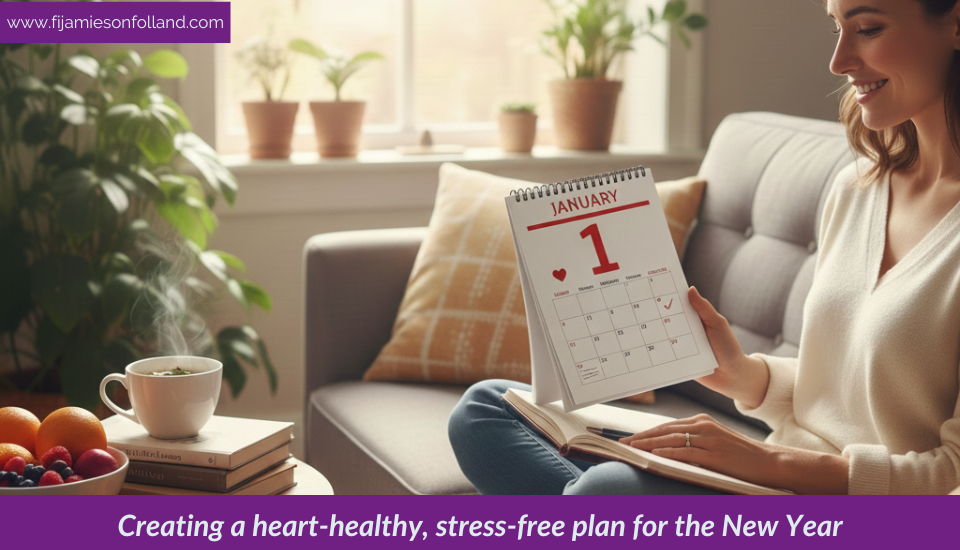
There’s something quietly hopeful about the cusp of a new year, a sense that the calendar turning is not just about days and dates however about possibilities, a fresh page, a gentle invitation to pause, reflect, and consider how we want our lives — and our hearts — to feel in the months ahead.
For many of us, the holiday season leaves us a little frayed at the edges, carrying a mix of joy, exhaustion, indulgence, and tension that can weigh heavily on both our physical and emotional health.
And yet, it’s precisely in these moments, when the contrast between how we feel and how we want to feel is most pronounced, that we have an extraordinary opportunity to design a heart-centred approach to life — one that honours our bodies, our emotions, and our own innate capacity for resilience.
It can be powerful to begin this process not by setting rigid resolutions, instead by reflecting gently on the past year – noticing moments when our hearts felt full, when stress felt manageable, and even when tension crept in. Perhaps it was the peaceful early morning walk with a cup of tea, the laughter shared with friends at a gathering, or the quiet sigh at the end of a long day when everything finally felt in place. These are not grand milestones – instead they’re small, significant markers of what brings ease and joy to your life. Recognising them allows you to carry forward practices that nurture your heart instead of repeating habits that create strain.
Honouring the lessons of the past year
Reflection isn’t just about cataloguing victories; it’s also about noticing patterns that may have contributed to stress or heart tension. Perhaps you found yourself skipping meals, working late into the night, or saying yes to obligations that left you depleted.
Rather than judging yourself, trial approaching these observations as gentle lessons — data, if you will, from which your heart can guide you toward wiser choices. There’s profound power in noticing without criticism, and this subtle shift in perspective can dramatically influence how you plan for the year ahead.
One practical approach is to journal for a few minutes each evening – simply noting what felt supportive and what felt draining. Over time, these reflections create a map of your natural rhythms, helping you understand when your energy is highest, when your stress peaks, and what kinds of activities genuinely rejuvenate you. This map becomes the foundation for a heart-healthy, stress-conscious plan — one that doesn’t rely on willpower alone.
It honours your body’s signals.
Redefining what heart health means to you
Heart health is often narrowly defined as blood pressure, cholesterol levels, or exercise minutes logged. While these are important, I invite you to take a more expansive view. Heart health includes emotional and mental well-being, the capacity to respond to stress with resilience, the ability to experience joy without guilt, and the simple freedom to breathe deeply and fully in any moment. When we frame heart health holistically, we create space for practices that are not only sustainable, they’re also deeply nourishing.
For instance, consider small rituals that blend physical, emotional, and social dimensions – a morning walk that doubles as meditation, a short gratitude journaling practice shared with a loved one, or a playful dance session that lifts your mood and circulates energy. These acts, when repeated, form a protective shield around your heart, buffering against the subtle erosion of stress that often accumulates unnoticed throughout daily life.
Setting intentions instead of resolutions
The language we use matters.
Instead of rigid resolutions that can feel like a list of obligations, trial setting intentions that reflect values and aspirations.
For example, rather than committing to ‘exercise five times a week,’ you might set an intention to ‘move in ways that feel joyful and energising.’ The shift is subtle and yet it’s profound – one focuses on external achievement, the other on internal alignment and sustainable habit formation.
Intentions can be as simple as noticing your breath before meals, prioritising sleep, or savouring one small pleasure each day. The goal is not perfection; it is mindfulness, consistency, and connection to the rhythms that truly support your heart. By approaching the year with intentions, you give yourself permission to experiment, adapt, and celebrate progress in ways that feel authentic rather than punitive.
Creating a supportive environment
Your environment shapes your habits more than sheer willpower ever could. The New Year is a perfect time to create spaces — both physical and emotional — that nurture heart health. This might mean organising your kitchen so wholesome foods are easily accessible, setting up a quiet corner for reflection or stretching, or communicating boundaries with family and friends to protect your energy.
Even small adjustments can have a cumulative effect. Perhaps you designate a particular time each morning for a brief walk, or place a journal and pen by your bedside to capture morning thoughts. These seemingly minor changes signal to your nervous system that you are prioritising yourself, reinforcing both physical and emotional resilience. 1
Movement as a joyful anchor
Exercise doesn’t have to be gruelling or overly structured to benefit the heart. In fact, movement is most protective when it’s approached with curiosity and joy rather than obligation. Imagine a brisk walk in the fresh air, a gentle yoga session in your living room, or a playful dance to a favourite song — each of these practices circulates blood, releases stress hormones, and stimulates endorphins that naturally support heart function.
A reflective approach to movement involves tuning into your body – noticing how your chest expands with each breath, how your heart rate responds, and how energy flows through your limbs. When movement is framed as a celebration of what your body can do rather than a task to check off a list, it transforms into a deeply nourishing act that reinforces your New Year intentions.
Mindful nutrition without guilt
Food is often at the intersection of stress and heart health. Instead of strict rules or diets, consider mindful eating practices that support both nourishment and pleasure. This might include pausing before meals to notice colours, textures, and flavours, or setting the intention to eat without distraction. By paying attention to hunger and satiety cues, you naturally support cardiovascular health, improve digestion, and cultivate a more compassionate relationship with food.
Another practical tip is to frame indulgences as conscious choices rather than lapses in discipline. Enjoy a piece of chocolate fully, savour each bite, and then return to nourishing foods without guilt. These small adjustments reduce the chronic stress that often accompanies holiday indulgence and New Year dietary resolutions.
Stress management as a daily practice
Stress is inevitable; however its impact on the heart is not. It can be valuable to integrate small daily stress-management practices that feel attainable rather than overwhelming. Simple strategies might include a five-minute guided meditation, a brief pause to stretch and breathe, or listening to music that uplifts your mood. The key is consistency, not duration — brief however repeated practices create cumulative protection for the heart.
Additionally, recognising your stress triggers allows for pre-emptive strategies. Perhaps social media scrolling triggers tension, or certain work deadlines cause anticipatory anxiety. Awareness enables you to create mini-safety nets — turning off notifications, delegating tasks, or scheduling micro-breaks — each of which reduces the subtle, ongoing load on your cardiovascular system.
Rest as a foundation
Sleep and rest are often undervalued, yet they are the cornerstone of a heart-healthy, stress-free plan. Rather than aiming for strict schedules that might feel restrictive, focus on cultivating restorative sleep habits – a consistent wind-down routine, a calm bedroom environment, and gentle transitions from busy days to restorative nights. Short daytime pauses, or ‘micro-naps,’ can also recharge both emotional and physical resilience.
Pay attention to signals your body sends – yawns, tension, irritability — these are not weaknesses, instead they’re messages from your heart and nervous system asking for care. Responding with kindness and consistency builds a rhythm that supports both heart health and emotional balance.
Connection and community
Heart health isn’t only about individual choices; it’s also profoundly influenced by social connections. Cultivating supportive relationships, whether through family, friends, or community, strengthens emotional resilience and buffers against stress. Even brief interactions — a phone call, a text check-in, or a shared cup of tea — can stimulate oxytocin (the ‘hug hormone’), which supports cardiovascular function and reduces stress markers.
Equally important is connection with yourself.
Taking time to reflect, journal, or simply notice your heartbeat and breath fosters a sense of internal safety and self-compassion, allowing you to navigate the New Year with clarity and confidence.
Embracing flexibility and adaptability
One of the most crucial aspects of a sustainable, heart-cantered plan is flexibility. Life is unpredictable, and rigid plans can quickly become sources of stress rather than relief. Approach your intentions with curiosity and adaptability. If a workout is missed, if sleep is disrupted, or if obligations shift, respond with self-compassion rather than self-criticism. Your heart thrives in a framework that balances structure with grace, allowing you to adjust while maintaining alignment with your core intentions.
Practicing gratitude and celebration
Gratitude is a subtle yet powerful heart-strengthening tool. Reflecting on small daily victories, moments of connection, or even simple joys like morning sunlight can lower stress hormones and support emotional resilience. Consider a nightly gratitude reflection or a weekly journal entry focused on wins, lessons, and moments of ease. Celebrating even small progress helps reinforce positive habits and keeps your heart engaged in the rhythm of intention rather than obligation.
Creative expression for heart-cantered joy
Art, music, writing, or movement offer a gentle release for emotional tension. Engaging in creative expression allows for processing of experiences, release of accumulated stress, and stimulation of endorphins that nourish both mind and body. Perhaps you try a morning sketch, a short poem, or a playful dance session. These acts remind your heart that joy can coexist with intention and that emotional expression is a valid form of self-care.
Reflective planning and gentle goal setting
Finally, creating a heart-healthy, stress-free plan for the New Year involves reflection combined with gentle goal setting. Instead of overwhelming lists or lofty resolutions, focus on three to five intentions that feel meaningful and achievable. Write them down, revisit them weekly, and adjust as needed. By pairing reflection with intentionality, you create a living plan that evolves with your life rather than fighting against it.
See you on this week’s #AlivewithFi ☺
Fi Jamieson-Folland D.O., I.N.H.C., is The LifeStyle Aligner. She’s an experienced practitioner since 1992 in Europe, Asia and New Zealand as a qualified Osteopath, Integrative Nutrition Health Coach, speaker, educator, writer, certified raw vegan gluten-free chef, and Health Brand Ambassador.

Facebook Instagram LinkedIn Pinterest YouTube
1 An interesting study – mindfulness and cardiovascular health – Qualitative findings on mechanisms from the mindfulness-based blood pressure reduction (MB-BP) study
https -//journals.plos.org/plosone/article?id=10.1371/journal.pone.0239533