
There is a quiet kind of power in the food you choose each day, and I don’t mean power in the loud, dramatic, overnight-transformation sense.
Instead I mean in the steady, almost invisible way your body responds when you begin to nourish it differently, when you start to feed your heart not just calories. I remember a period in my life when stress felt like a constant companion. It wasn’t sharp and overwhelming – it was persistent, like a background hum I couldn’t switch off, and what surprised me the most wasn’t just how it affected my thoughts or my sleep, it was how deeply it settled into my body…
The tightness in my chest,
shallow breathing,
a sense that my system was always slightly on edge.
What I didn’t fully understand at the time was how much my food choices were either amplifying that stress or gently soothing it.
Because here’s something most people overlook—your meals are not just fuel, they are signals, biochemical messages that either encourage your body to relax, repair, and rebalance, or keep it in a subtle state of tension. And when you begin to lean into a plant-based way of eating, especially with intention, something shifts, not just in your physical health – it shifts in the way your body experiences stress itself.
The connection between plant-based eating and a calmer heart
When we talk about heart health, we often default to the obvious markers—cholesterol, blood pressure, weight—although beneath all of that is the state of your nervous system, quietly influencing everything.
A whole-food, plant-based diet naturally supports a more balanced internal environment, rich in fibre, antioxidants, minerals, and phytonutrients that help reduce inflammation and support vascular health. There is also a deeper layer to consider, and that is how this way of eating can influence your stress response.
Foods that are closer to their natural state tend to be easier for the body to process, less taxing on digestion, and less likely to create those spikes and crashes that leave you feeling wired and tired all at once. Instead, they create steadiness, and steadiness is deeply calming for the heart.
The rhythm of eating – why how you eat matters as much as what you eat
Before we even get to recipes, it is worth gently shifting your attention to something that often gets missed, and that is the rhythm of your eating. You can have the most beautiful, nutrient-dense plant-based meal in front of you, yet if you are eating it quickly, distracted, or in a state of stress, your body does not receive it in the same way. Digestion becomes less efficient, your nervous system stays activated, and the calming benefits are quite literally diluted.
One of the most powerful practices you can adopt is to slow down. Take a gratitude-breath before you begin and allow your body to register that it is safe to receive nourishment. This simple act can transform the way your meals support your heart.
Breakfast that steadies your system
There is something grounding about starting your day with a meal that feels nourishing, balanced, and gently energising rather than overly stimulating. A thoughtfully prepared breakfast can help stabilise your energy, support your nervous system, and set a calm tone for the hours ahead.
A simple option is a plant-based breakfast bowl built around whole, colourful ingredients. You might combine fresh fruit, a handful of nuts and seeds, and a base such as coconut yoghurt or a smoothie blend made with greens and berries. Adding a sprinkle of flaxseeds or chia seeds for healthy fats, and perhaps a touch of cinnamon or nutmeg for warmth and flavour can work well.
This kind of combination supports steady energy release, provides essential nutrients, and helps your body ease into the day without sudden spikes or crashes. It is not just about nourishment, it is about creating a sense of ease and balance from the very beginning.
Midday meals that support clarity without overwhelm
Lunch is often where things go off track, rushed, eaten at a desk, or skipped entirely (although timing of meals will vary according to what works for you eg you might find that intermittent fasting suits your daily rhythm and therefore lunch might be less prominent in your day), leading to that mid-afternoon crash that leaves your body searching for quick energy. Instead, think of lunch as an opportunity to reset, not heavy or overly complex, instead balanced and grounding.
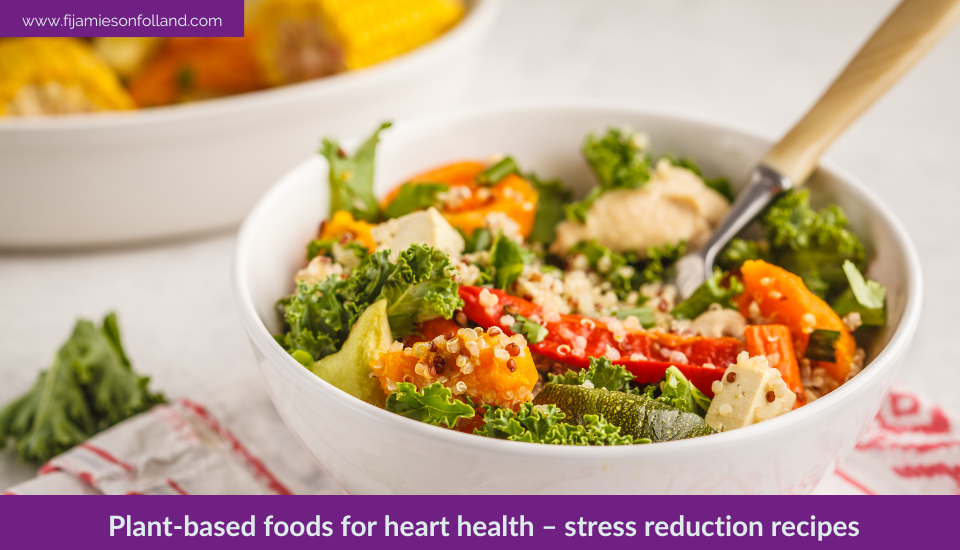
Examples of nourishing options might include – for those who prefer cooked foods – a warm quinoa bowl with roasted vegetables and a tahini drizzle.
So the roasted vegetables such as sweet potato, courgette, capsicum, and red onion can bring depth and natural sweetness, while quinoa provides plant protein and sustained energy. A simple tahini dressing with lemon and a hint of garlic ties everything together in a way that can feels both satisfying and nourishing.
This kind of meal supports stable blood sugar levels, helping you avoid the sharp dips that can trigger stress responses in the body. Just as importantly, it invites you to pause, to sit, and to eat with intention, even if only for a short time.
The calming power of simple snacks
Snacking does not need to be reactive or chaotic. When approached with intention, it becomes another opportunity to support your heart and maintain a steady internal state throughout the day. Choosing simple, whole foods helps provide consistent energy without overwhelming your system.
Options such as sliced apple with sunflower seed or almond butter, a small handful of activated or pre-soaked raw nuts, or vegetable sticks with hummus offer a balance of nutrients that keep you satisfied between meals. These choices may seem simple, althoughr their simplicity is exactly what makes them effective. They help maintain balance, reduce the likelihood of energy crashes, and support a more relaxed physiological state.
Dinner as a ritual, not just a meal
Evenings offer a natural opportunity to slow down, to move out of the activity of the day and into a more restful rhythm. Your evening meal can either support this transition or work against it. A rushed, heavy dinner eaten in a distracted state tends to keep your system alert, while a mindful, plant-based meal can help signal that it is time to unwind.
Your evening meal might be a multi-leaf salad with steamed veggies and marinated, grilled tofu. Or you might prefer a hearty lentil and vegetable stew (lentils simmered with garlic, onions, carrots and celery, along with herbs such as thyme and bay leaf).
The idea is to create a dish that is both nourishing and deeply satisfying. The simplicity and or warmth of these kinds of meals support digestion and encourage a sense of grounding.
When eaten slowly and in a calm environment, dinner becomes more than just nourishment. It becomes a transition point, gently guiding your body toward rest.
The role of colour in calming the body
There is something almost intuitive about the way colourful plant foods make us feel, and there is good reason for this. Different colours represent different phytonutrients, many of which have antioxidant and anti-inflammatory properties that support our heart health.
Beyond the science, there is also a sensory experience. A vibrant plate feels alive, inviting you to engage more fully with your meal. This encourages presence, and presence itself has a calming effect on the nervous system. Rather than focusing on restriction, it can be helpful to think in terms of adding more variety and colour to your plate, allowing your meals to become both nourishing and visually satisfying.
The science behind plant-based heart support
This way of eating is supported by strong research. A study 1 published in the Journal of the American College of Cardiology highlights how diets rich in whole plant foods are associated with a lower risk of cardiovascular disease and improved heart health markers.
What this reinforces is that consistent, plant-based choices can have a meaningful impact on heart health over time, supporting both physical function and overall wellbeing.
Reducing stress through preparation, not perfection
One of the hidden sources of stress around food is the pressure to get everything exactly right. That pressure can turn something nourishing into something tense.
A more supportive approach is to focus on preparation rather than perfection.
Having a few ingredients ready, knowing a handful of simple recipes, and allowing flexibility in your meals can make a significant difference. When food feels manageable and enjoyable, your body responds with greater ease, and that sense of ease supports your heart just as much as the nutrients themselves.
Hydration as a quiet yet powerful ally
Hydration is often overlooked, although it plays an important role in how your body manages stress plus supports your circulation. Even mild dehydration can place additional strain on your system, requiring your heart to work harder to maintain balance.
Sipping water consistently throughout the day helps support overall function. Adding slices of lemon, cucumber, or fresh herbs can make this feel more enjoyable and less like a task. Small, consistent habits like this quietly contribute to a more balanced internal environment.
Creating a lifestyle, rather than a diet
A plant-based approach to heart health is not about strict rules or limitation. It is about creating a way of living that feels supportive, sustainable, and nourishing. It is about meals that calm as well as fuel, moments of pause within your day, and a relationship with food that feels balanced and kind.
Your heart responds to how you live, how you feel, and how you care for yourself on a daily basis – besides simply the food your eat. When these elements come together, the result is a more resilient, steady, and supported system.
Closing thoughts
If you’re wondering where to begin, start simply.
Choose one meal, one recipe, or one small shift in how you eat, and allow that to be enough. Over time, these small, consistent changes build into something far more powerful than any quick fix.
Your heart benefits from the accumulation of these choices, from the steadiness they create, and from the sense of care they represent. True heart health is not found in extremes, – instead it’s found in the quiet, consistent ways you support your body each day.
With heartfelt support, and see you on this week’s #AlivewithFi 🙂
Fi Jamieson-Folland D.O., I.N.H.C., is The LifeStyle Aligner. She’s an experienced practitioner since 1992 in Europe, Asia and New Zealand as a qualified Osteopath, Integrative Nutrition Health Coach, speaker, educator, writer, certified raw vegan gluten-free chef, and Health Brand Ambassador.

Facebook Instagram LinkedIn Pinterest YouTube
1 A study titled ‘Plant-Based Diets and Cardiovascular Health’ published in the Journal of the American College of Cardiology highlights how diets rich in whole plant foods are associated with a lower risk of cardiovascular disease and improved heart health markers.https -//www.jacc.org/doi/10.1016/j.jacc.2017.12.061