
When we think about eating for our heart, there’s an interesting conversation happening about the relationship between what we eat and how we feel. Food doesn’t simply provide fuel – it interacts with the gut, the brain, the immune system and our metabolism. So this means the way we eat may influence far more than our physical health.
This is where a predominantly plant-based approach becomes particularly interesting, because it isn’t about following a rigid diet or suddenly becoming vegan. It is about gradually creating a pattern of eating in which plants become the colourful, varied foundation of your meals while also making eating itself a more nourishing and enjoyable experience.
Start with abundance rather than restriction
One of the biggest psychological mistakes we can make with healthy eating is beginning with a list of everything we supposedly ‘shouldn’t’ have.
Instead, I invite you to turn the question around.
What could you add in?
Could you add berries to breakfast,
leafy greens to lunch,
herbs and vegetables to dinner,
a handful of nuts or seeds as a snack,
beans or lentils to a meal,
or a piece of fruit when you would normally reach for something highly processed?
This approach creates abundance rather than deprivation, and psychologically that can feel completely different.
The aim is not to eat a perfect plant-based diet – instead it’s to gradually increase the diversity of whole plant foods that appear throughout your week.
Feed your gut and your heart
Your digestive system and nervous system are in constant communication, and the gut microbiome is one of the fascinating pathways through which diet may influence overall wellbeing.
Plant foods provide a wide variety of fibres and other compounds that interact with the microorganisms living in your digestive tract, so instead of obsessing over a single ‘superfood’, think about diversity.
Trial rotating berries, apples, kiwifruit, leafy greens, broccoli, carrots, beetroot, capsicum, mushrooms, legumes, nuts, seeds, herbs and spices rather than eating exactly the same few foods every day.
And if your digestive system is sensitive, it might be wise to avoid suddenly going from very little fibre to enormous bowls of legumes and raw vegetables overnight. Increase variety gradually and pay attention to what your own body tells you.
Choose foods that make your energy feel steadier
Stress and eating can create an interesting cycle.
Maybe you have a demanding morning, forget to eat, become ravenously hungry, grab something convenient, experience a temporary energy boost and then find yourself tired, irritable or craving something else a few hours later.
A more supportive approach is to build meals around a combination of plant foods that provide fibre, protein and healthy fats.
Think lentils with vegetables and tahini or olive oil, chickpeas with salad and an almond butter sauce, tofu with colourful vegetables, or a substantial salad containing faba beans, seeds, avocado and plenty of herbs.
We don’t need to fear carbohydrates either. Whole-food sources such as legumes, vegetables, fruit and intact whole grains can be part of a heart-supportive dietary pattern, with the right choices depending on your individual tolerance and nutritional needs.
Make colour your daily challenge
Here’s a simple experiment that can turn nutrition into something visual rather than mathematical.
Instead of counting calories or nutrients, count colours.
How many different natural colours can you put on your plate today?
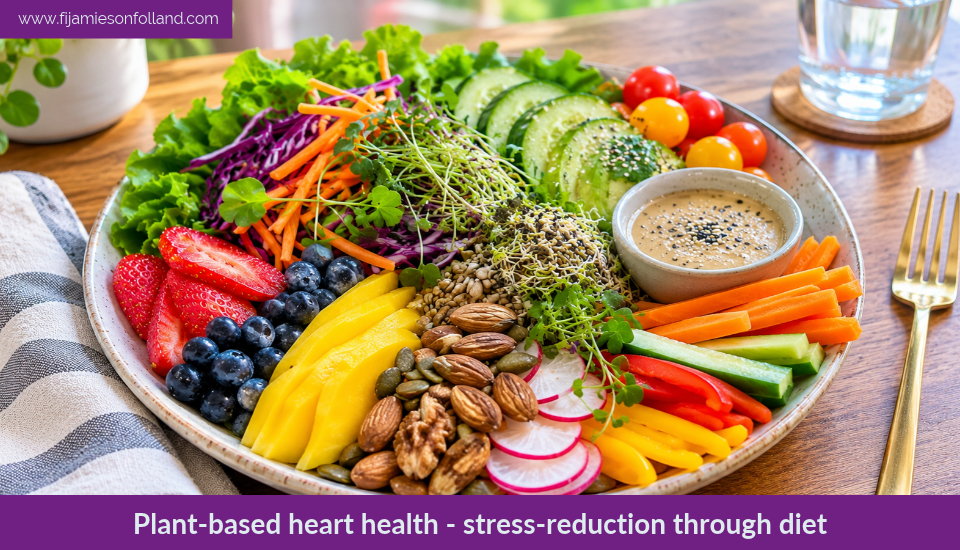
Deep purple berries, bright green leaves, orange pumpkin, red and yellow capsicum, white cauliflower, brown mushrooms, black beans.
Different plant foods contain different combinations of polyphenols, carotenoids and other bioactive compounds, so variety matters.
Your plate is at its healthiest when it looks alive!
And there’s something psychologically uplifting about preparing a meal that’s genuinely beautiful.
Remember healthy fats
Plant-based heart health doesn’t mean fat-free.
Extra virgin olive oil, avocado, walnuts, almonds, sunflower, pumpkin and chia seeds, flaxseeds can add satisfying texture and flavour while contributing unsaturated fats and other beneficial compounds.
This is particularly important because food needs to be pleasurable if you want healthy eating to become a lifestyle rather than a short-term project.
A bowl of vegetables that leaves you hungry and dissatisfied isn’t necessarily going to help you create sustainable habits.
Add flavour.
Add texture.
Add herbs.
Add spices.
Add a drizzle of virgin, organic olive oil.
Make the healthy option the option you actually look forward to eating.
Let meals become a stress-reduction ritual
There’s another part of the food conversation that we rarely discuss – how we eat.
If you’re standing at the kitchen bench eating quickly while answering messages, your meal can become another stressful event in an already busy day.
Instead, occasionally make one meal completely screen-free.
Sit down.
Look at your food.
Notice the aroma.
Take your time.
Talk to someone if you’re eating with company.
Let the meal become a pause rather than another task to complete.
This is not about being precious with food. It is about recognising that nourishment happens within a whole environment, not just inside the nutritional information of the meal.
Explore the gut-brain connection
There’s emerging human research suggesting that dietary patterns rich in prebiotic and fermented foods may influence perceived stress through interactions with the gut microbiome, although the evidence is still developing. One small randomised trial involving 45 healthy adults found that participants assigned to a four-week psychobiotic diet, which emphasised prebiotic and fermented foods, reported a reduction in perceived stress within the intervention group. 1
The takeaway isn’t that you need to follow a special ‘psychobiotic diet’.
It’s much simpler – regularly eating a diverse range of plant foods, including fibre-rich foods and suitable fermented foods, is one interesting way to support the gut environment while also adding variety to your diet.
Slow down your definition of healthy eating
Perhaps the most important shift is to stop thinking about heart-healthy eating as a temporary project.
Your heart doesn’t need a perfect Monday followed by an exhausted Friday.
It needs a pattern.
A pattern –
– of colourful plants
– of nourishing meals
– of enough fibre and healthy fats
– of eating that supports steady energy
…that leaves room for enjoyment, connection and flexibility.
And there’s something wonderfully calming about this approach because it removes the pressure to get everything right.
You don’t need to transform your entire diet tomorrow.
Start by adding one extra plant to a meal.
Then another.
Trial a new vegetable each week.
Add herbs and spices.
Experiment with beans.
Eat a handful of nuts.
Choose fruit for colour and pleasure.
Sit down when you eat.
Over time, these tiny decisions become a dietary pattern, and that pattern can become part of the bigger picture of heart health, resilience and longevity.
Because perhaps the most heart-supportive way to eat isn’t about restriction at all…it’s about creating a relationship with food that nourishes your body, supports your wellbeing and makes you genuinely want to sit down and enjoy the meal in front of you.
See you on this week’s #AlivewithFi 🙂
Fi Jamieson-Folland D.O., I.N.H.C., is The LifeStyle Aligner. She’s an experienced practitioner since 1992 in Europe, Asia and New Zealand as a qualified Osteopath, Integrative Nutrition Health Coach, speaker, educator, writer, certified raw vegan gluten-free chef, and Health Brand Ambassador.

Facebook Instagram LinkedIn Pinterest YouTube
1 Feed your microbes to deal with stress – a psychobiotic diet impacts microbial stability and perceived stress in a healthy adult population