There was a season in my life when I thought exhaustion was a badge of honour. I believed that pushing harder, staying available for everyone, carrying emotional burdens silently, and running on adrenaline somehow made me stronger or more worthy. My nervous system was permanently switched on, my sleep became shallow and fractured, my shoulders felt welded to my ears, and even when I sat still my heart seemed to be sprinting ahead of me as though it had somewhere urgent to be.
What I didn’t understand at the time was that the heart listens to everything.
It listens to pressure, grief, rushing, unresolved fear, and the relentless internal dialogue that says, ‘keep going… just keep going.’ While most people think of cardiovascular wellness as something connected only to food, exercise, or genetics, stress quietly weaves itself into every one of those areas like an invisible thread, influencing blood pressure, inflammation, sleep quality, heart rhythm, digestion, hormone balance, and even the way we breathe.
The truth is that overwhelm is not simply ‘in your head.’ It becomes biological. Ignore it long enough and the body eventually begins speaking louder than the mind.
The refreshing news is that the opposite is also true.
When you begin calming the nervous system, restoring emotional balance, slowing the pace of your internal world, and supporting your body consistently instead of sporadically, the heart often responds with remarkable gratitude. Not overnight and not magically. Instead – it responds steadily. Cardiovascular wellness is not created through punishment.
It is created through rhythm.
The hidden relationship between stress and the heart
Most people associate stress with feeling mentally frazzled, emotionally reactive, or physically tense, however chronic stress reaches far deeper than mood alone. When the body perceives ongoing stress, whether from work pressure, financial fear, relationship strain, care giving exhaustion, loneliness, unresolved trauma, or years of self-imposed perfectionism, it activates the sympathetic nervous system, often called the ‘fight or flight’ response. Adrenaline rises, cortisol increases, blood vessels constrict, heart rate accelerates, breathing becomes shallow, sleep becomes lighter, and inflammatory processes may intensify.
When this state becomes chronic rather than occasional, the body stops recognising what true rest even feels like. I witness this frequently in people who tell me they are exhausted although unable to switch off, wired yet depleted, or waking in the middle of the night with their mind racing before their feet even touch the floor.
This is not weakness.
It is a nervous system that has forgotten how to feel safe.
The challenge is that modern life often rewards this state. People praise productivity while quietly sacrificing peace.
They celebrate hustle while normalising exhaustion.
They glorify busyness while disconnecting from their own biology.
Meanwhile the heart keeps absorbing the cost.
The reason overwhelm affects cardiovascular wellness so deeply
The heart and nervous system are intimately connected. You cannot separate emotional stress from physical health because the body does not separate them.
A difficult conversation can increase heart rate.
Financial fear can elevate blood pressure.
Chronic worry can disrupt sleep for years.
Suppressed emotion can tighten muscles, alter breathing patterns, and increase nervous system load.
Even something as simple as constantly rushing changes physiology.
Think about how many of us live – eating while driving, answering emails while talking, scrolling while watching tv, and thinking about tomorrow while ignoring today.
The nervous system never fully lands.
The body interprets that constant state of vigilance as danger.
One of the most overlooked truths in cardiovascular wellness is that the body heals most effectively when it feels safe enough to shift out of survival mode. Not lazy.
Not unmotivated.
Safe.
That shift changes everything.
Learning to regulate instead of merely cope
Many people become experts at coping while never truly regulating their nervous system. There is a profound difference between the two.
Coping says, ‘I’ll push through.’
Regulation says, ‘I’ll listen before my body screams.’
Coping relies on willpower while regulation creates resilience, and resilience is what protects the cardiovascular system over the long term.
One of the most powerful things you can do is create moments throughout the day where your body experiences genuine downshifting. Not numbing, distraction, or collapsing in front of a screen while mentally overstimulated.
Instead – true downshifting.
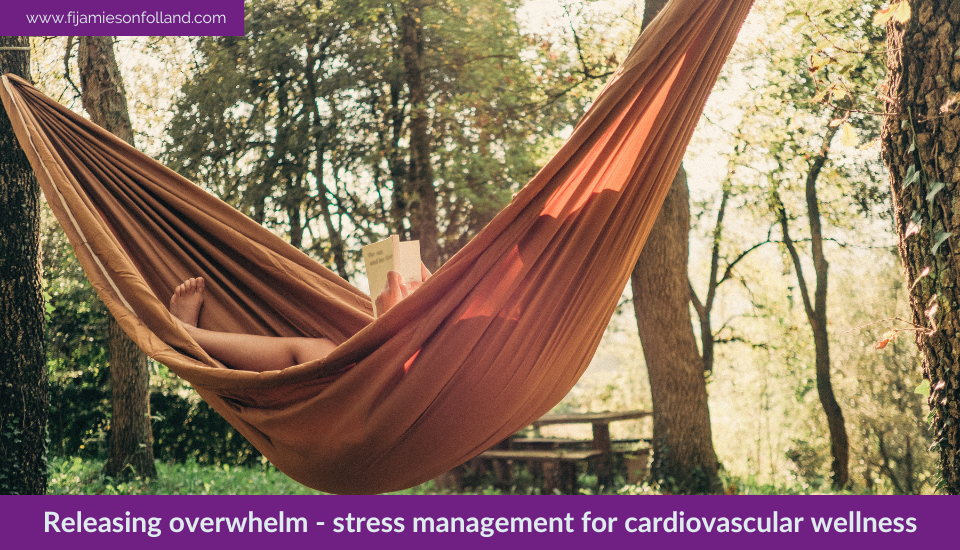
That might look like sitting outside barefoot in morning sunlight while breathing slowly…
…investing five minutes between appointments to consciously relax your jaw and shoulders…
…listening to calming music while cooking instead of consuming upsetting news…
…or learning that rest is productive because it restores your biology.
Small moments matter more than most people realise because the nervous system responds to repetition. Tiny acts of calm practised consistently create profound change over time.
Breathing – the overlooked cardiovascular tool hiding in plain sight
It amazes me how many of us spend years searching for complicated solutions while ignoring the one tool they carry every moment of every day – their breath. When stress rises, breathing usually becomes fast, shallow, and chest-dominant. The body tightens, the diaphragm moves less, and the nervous system becomes more alert.
When breathing slows intentionally, especially with longer exhalations, something remarkable happens. The body begins receiving signals of safety. Heart rate may soften, muscle tension can decrease, the mind becomes less chaotic, and the nervous system starts shifting toward parasympathetic dominance, often called the ‘rest and restore’ state (I call it the ‘rest, digest and heal’ mode.)
One of my favourite calming practices is simple yet oh-so-effective.
Inhale gently through your nose for four seconds, then exhale slowly for six seconds.
Repeat for five minutes.
Not aggressively, not perfectly, just softly and consistently.
You’ll be amazed what regular practice can do for the way a person feels physically and emotionally.
Research has shown mindfulness-based stress reduction may help reduce blood pressure and cardiovascular stress reactivity. One published study titled ‘Mindfulness-based stress reduction and physiological activity during acute stress – a randomized controlled trial’ found reductions in systolic and diastolic blood pressure responses during stress after mindfulness training. 1
The cardiovascular power of slowing down meals
One of the most underrated stress-management strategies for heart health has nothing to do with exercise, it’s how you eat.
So many people eat in a physiologically stressed state while standing, driving, scrolling, working, or rushing through meals without ever fully tasting their food.
The body cannot optimise digestion while simultaneously preparing for battle. When meals are rushed, stress chemistry remains elevated and digestion often suffers. People may experience bloating, discomfort, reflux, poor chewing, overeating, or unstable energy afterward.
When you slow down before meals, even briefly, the body shifts. It can work wonders to pause for sixty seconds before eating. Not for perfection or ritualistic pressure, instead it’s simply to breathe, relax the shoulders, notice the food, and allow your body to transition into a calmer state. That tiny moment creates physiological change, and over months and years these tiny shifts compound into a profoundly different internal environment.
Sleep deprivation and the exhausted heart
It’s not possible to build cardiovascular wellness on a foundation of chronic exhaustion. Sleep is where repair, hormonal recalibration, nervous system recovery and emotional processing happens. Yet modern culture often treats sleep as though it is optional.
People proudly announce they survived on four hours of sleep, stay overstimulated until midnight, scroll endlessly through emotionally charged content, and then wonder why they wake anxious at 3am with racing thoughts and elevated tension.
The body craves rhythm.
One of the kindest things you can do for your heart is create an evening routine that tells your nervous system, ‘we are safe now.’
Dim the lights, reduce stimulation, lower noise, avoid emotionally charged media late at night, read something calming, stretch gently, practise slow breathing, listen to soft music, pray, reflect, or journal.
These are not luxuries.
They are nervous system nourishment.
Emotional suppression and cardiovascular strain
This is the part people rarely talk about. Unprocessed emotions create physiological stress because the body carries what the mind avoids. I have seen people improve their wellbeing dramatically when they finally stopped pretending they were ‘fine.’
The constantly smiling woman silently carrying grief, the businessman fuelled entirely by pressure, the caregiver who has not had a genuine emotional release in years, and the parent holding everything together while internally collapsing all share one thing in common – their bodies are absorbing emotional strain.
Emotions need movement. Sometimes healing begins with honest conversations. Sometimes with tears, therapy, prayer, or writing in a journal for ten quiet minutes before bed.
Your heart does not need perfection – it needs honesty.
Nature as nervous system medicine
One of the fastest ways to feel human again is to reconnect with the natural world. I don’t mean turning outdoor movement into another performance metric.
I mean genuinely being present outside – for example listening to birds, feeling sunlight on your skin, walking without headphones, watching waves move, touching trees, and breathing fresh air slowly instead of rushing through it unconsciously.
Nature has a way of reminding the nervous system that life is not meant to feel like permanent emergency.
It can be a useful step to stop trying to ‘biohack’ ourselves for a moment and instead simply go outside. Not because it sounds poetic i it’s because our biology responds to it.
Movement that calms instead of punishes
Exercise is important for cardiovascular wellness, although the relationship people have with movement matters deeply too. Some people use exercise as another form of stress through more intensity, more punishment, more guilt, and more pushing.
Movement can also become medicine for the nervous system.
Walking rhythmically, swimming, gentle cycling, stretching, dancing in the kitchen, gardening, mobility work, yoga, and tai chi regulate the body differently than frantic overtraining.
The goal is not merely burning calories – it’s to experience vitality. Your heart loves movement that nourishes rather than depletes.
Community, connection, and cardiovascular wellness
Human beings are not designed to heal in isolation, as loneliness itself creates physiological stress. Meaningful connection matters for the heart in ways modern society often underestimates.
A supportive conversation, laughter with friends, feeling emotionally seen, physical affection, shared meals, spiritual community, and safe relationships all regulate the nervous system profoundly. One heartfelt conversation can shift physiology more than people realise because the body softens when we feel connected.
In a world where many people are digitally connected although emotionally exhausted, genuine human presence has become almost medicinal.
Letting go of the myth that you must earn rest
This may be one of the most important reminders of all – you do not have to collapse before you deserve care. You do not need to ‘earn’ rest through burnout; you are allowed to protect your peace before your body forces you to.
So many high-achieving people unconsciously believe that slowing down equals failure ( I can definitely relate to having felt this myself – can you?) Healingoure nervous system often requires the exact opposite mindset. Rest is not weakness, stillness is not laziness, and boundaries are not selfishness – they are forms of cardiovascular protection.
Sometimes the bravest thing a person can do is stop glorifying survival mode.
Building a calmer heart one day at a time
Cardiovascular wellness is not created through occasional grand gestures, it is shaped quietly through daily rhythm. The way you breathe when stressed, the pace at which you eat, the quality of your sleep, the thoughts you repeatedly rehearse, the relationships you nurture, and the moments you allow yourself to pause all become biology over time.
While overwhelm may feel enormous, healing often begins very small.
One calming breath.
One early night.
One walk outside.
One boundary.
One honest conversation.
One quiet morning where your nervous system finally feels safe enough to exhale.
Your heart is listening to how you live – not just how you eat or how you exercise.
How you live.
Perhaps one of the most powerful acts of heart care is learning that peace is not something you stumble upon accidentally at the end of life.
It is something you practise daily, gently, imperfectly, and intentionally.
See you on this week’s #AlivewithFi 🙂
1 Nyklíček I et al. ‘Mindfulness-based stress reduction and physiological activity during acute stress – a randomized controlled trial’
https -//pubmed.ncbi.nlm.nih.gov/23527521/