
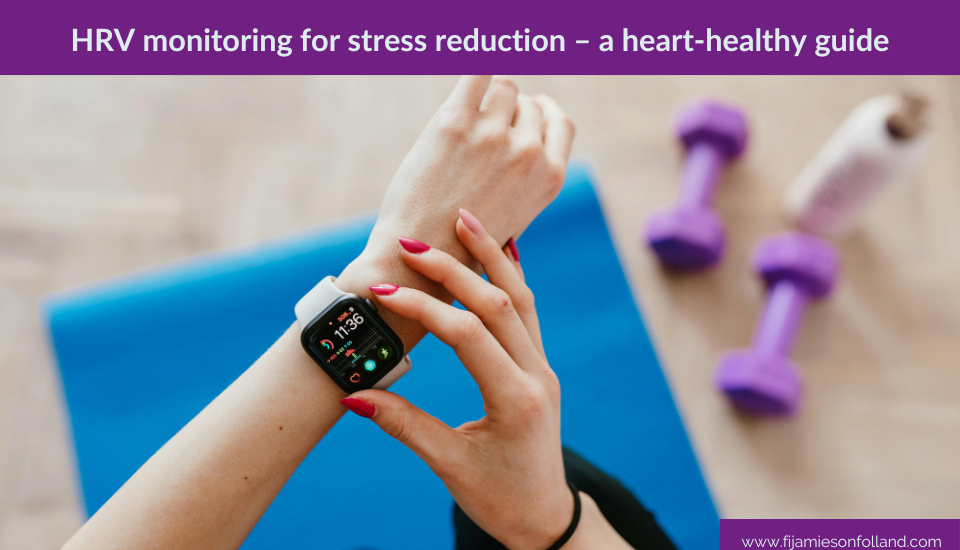
There is something fascinating about your heart that most of us never think about – it’s not actually supposed to beat like a metronome.
If you put your fingers on your wrist and count your heartbeat, you might imagine that a healthy heart should tick away at perfectly even intervals, however a healthy heart is actually constantly adapting. The time between one heartbeat and the next changes subtly, and this natural variation is known as heart rate variability, or HRV.
And here’s where HRV becomes particularly interesting.
Rather than simply telling you how fast your heart is beating, HRV can give you a window into how your nervous system is responding to life. It can reflect the balance between the part of your nervous system that helps you mobilise, respond and take action and the part that helps you recover, digest, restore and relax.
That makes HRV a fascinating tool for anyone wanting to understand stress more intelligently.
Your heart is listening to your life
Stress is not necessarily a bad thing, as your body is designed to respond to challenges, and a temporary rise in alertness can be incredibly useful.
The problem comes when the body rarely receives the message that it is safe to switch off.
Deadlines, emotional pressure, poor sleep, excessive training, travel, alcohol, illness, relationship difficulties, over-thinking and even the constant stream of notifications coming from our phones can all become little signals of demand.
Your HRV may respond to that changing internal environment.
When your system is coping well, you will often see greater flexibility in your heart rhythm, whereas periods of physiological or psychological strain can sometimes be accompanied by a reduction in HRV.
However this is where I encourage you to resist one of the biggest mistakes people make with HRV monitoring – treating one number as a verdict on your health.
It isn’t.
Think trends rather than scores
Your HRV can change from one day to the next, sometimes dramatically, and that does not automatically mean something’s wrong.
Instead of asking ‘is my HRV good today?’ it can be more useful to ask ‘what’s my HRV doing compared with my normal pattern?’
Your personal baseline matters far more than comparing your number with someone else’s.
A naturally lower HRV does not mean that you are unhealthy, just as a higher HRV does not guarantee exceptional health. Age, genetics, fitness, sleep, breathing patterns, stress, recovery and many other factors influence the measurement.
This is why it can be wise to become curious rather than judgemental about your data.
Think of your HRV as information, not a grade.
Create a morning check-in
One of my favourite ways it’s possible to use HRV is to turn it into a tiny morning ritual rather than something you obsessively check throughout the day.
Before you get swept into emails, news, work and other people’s demands, take a moment to notice your HRV trend alongside how you actually feel…
How did you sleep?
Do you feel refreshed or exhausted?
Are you calm, energised, flat or unusually irritable?
Has your HRV been trending downward for several days?
This combination of objective information and subjective awareness can be much more valuable than either one alone.
Your body is constantly communicating with you. HRV simply gives you another language in which to listen.
Use the number to change your behaviour
This is where HRV monitoring becomes genuinely powerful.
Imagine that you’ve had several nights of poor sleep and your HRV has also been consistently lower than your normal range. Rather than pushing yourself harder because your calendar says you should, you might decide that today is a better day for gentle movement, walking, stretching, earlier bedtime and a little less stimulation.
Conversely, if you’re sleeping well, feeling energetic and your HRV is comfortably within your normal range, that may give you confidence to train, work or challenge yourself appropriately.
The goal isn’t to chase a higher HRV.
The goal is to become better at responding to what your body is telling you.
Trial slow breathing when life feels rushed
Here is one simple experiment I particularly like.
When you notice yourself becoming tense, stop for a few minutes and deliberately slow your breathing. Rather than taking enormous breaths, allow the breathing to become smooth, gentle and rhythmic, with a comfortable, slightly longer exhalation.
You are not attempting to ‘force’ your heart rate down.
You are giving your nervous system a different signal.
Slow breathing can influence the natural relationship between breathing and heart rhythm, which is one reason breathing-based HRV practices have become such an interesting area of research.
A 2024 systematic review and meta-analysis examining stress-reducing interventions in people with cardiovascular disease found beneficial effects on several measures of HRV, supporting the idea that reducing physiological stress can influence autonomic regulation. 1
Don’t let your wearable become another stressor
There is an irony here that I see quite often.
Someone buys a sophisticated wearable to help them manage stress, then starts checking their HRV repeatedly, becomes anxious when the number falls, changes their behaviour dramatically and spends the rest of the day worrying about whether tomorrow’s number will be better.
That isn’t stress reduction.
If your HRV device is making you more anxious, step back.
You don’t need to monitor every fluctuation. A simple morning trend can be enough to develop awareness without becoming consumed by the data.
Your wearable needs to serve you, not the other way around.
Look for the patterns hiding underneath
Perhaps the most valuable part of HRV monitoring isn’t the HRV itself, it’s what you discover when you start connecting the dots.
Maybe your HRV consistently drops after several late nights.
Or it falls after periods of intense work.
Perhaps it improves when you spend more time outdoors.
Maybe your numbers respond positively when you practise breathing, walk regularly, create more space in your evenings or stop taking your phone to bed.
Suddenly, your wearable becomes less about technology and more about self-awareness. You begin to see which parts of your lifestyle genuinely help your nervous system recover.
Your heart loves flexibility
Ultimately, heart health isn’t just about making the heart work harder – it’s also about giving the body opportunities to recover.
A healthy nervous system needs both activation and restoration, challenge and recovery, effort and stillness. HRV gives us a fascinating glimpse into that flexibility.
So rather than waking up tomorrow and asking, ‘what is my HRV number?’ trial asking something more meaningful – maybe ‘what is my body telling me today, and what would help it feel safer, calmer and more resilient?’
That shift—from measuring yourself to listening to yourself—may be one of the healthiest ways to use HRV.
Because the real goal isn’t a perfect HRV score.
It is a heart and nervous system that can adapt beautifully to the demands of life, and then know how to come back to balance.
See you on this week’s #AlivewithFi 🙂
Fi Jamieson-Folland D.O., I.N.H.C., is The LifeStyle Aligner. She’s an experienced practitioner since 1992 in Europe, Asia and New Zealand as a qualified Osteopath, Integrative Nutrition Health Coach, speaker, educator, writer, certified raw vegan gluten-free chef, and Health Brand Ambassador.

Facebook Instagram LinkedIn Pinterest YouTube
1 The effect of stress-reducing interventions on heart rate variability in cardiovascular disease – a systematic review and meta-analysis’ — Life, 2024.
https://www.mdpi.com/2075-1729/14/6/749