
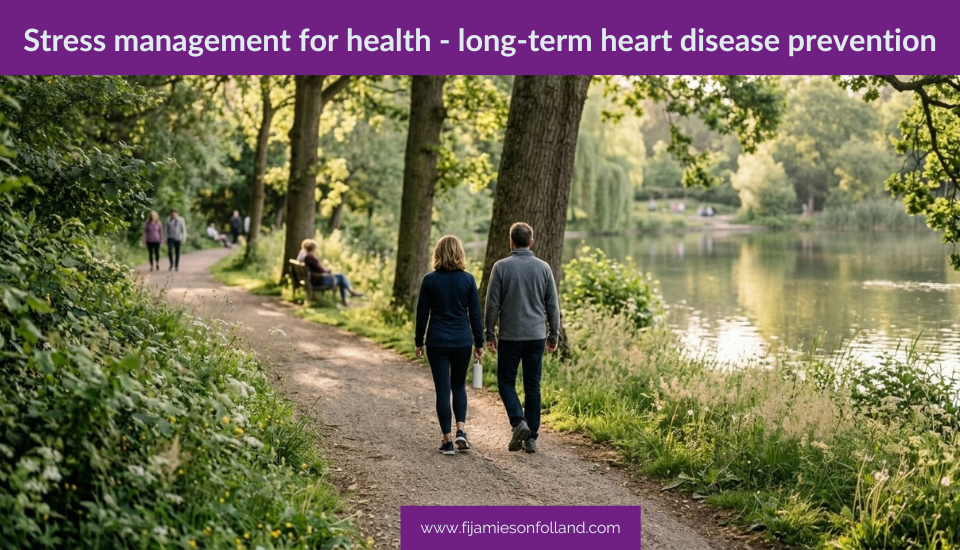
We tend to think of stress as something that happens to us when life gets particularly difficult, however the more important question for long-term heart health may be what happens when stress becomes the background noise of everyday life.
The deadlines, family responsibilities, financial worries, endless notifications, difficult conversations and constant feeling that there’s something else we should be doing can gradually create a state of emotional and physical tension that starts to feel normal.
Although your body doesn’t necessarily see it as normal.
When we’re under pressure, the body is designed to respond by becoming more alert and ready for action, and that response is incredibly useful when we genuinely need it. The challenge comes when the switch is rarely turned off. Long-term stress can influence sleep, behaviour, blood pressure, physical activity, eating patterns and the way we emotionally respond to everyday life, which is why learning to manage stress isn’t simply about feeling calmer; it’s an important part of creating a heart-healthy lifestyle for the decades ahead.
Recognise your personal stress signature
Stress doesn’t look the same in everyone, which means one of the most useful things you can do is learn your own early warning signs. Perhaps you become impatient with people you normally enjoy being around, start waking during the night, find yourself reaching for your phone constantly, lose motivation to exercise or notice that your thoughts are racing even when nothing particularly dramatic is happening.
These subtle changes can be much more useful than waiting until you feel completely overwhelmed. Think of them as your body’s dashboard warning lights. When you recognise your personal pattern early, you have an opportunity to make adjustments before stress becomes deeply embedded in your day.
Stop treating everything as urgent
Modern life has created a strange psychological environment in which almost everything can feel immediate. A message arrives and we respond, an email appears and we read it, someone asks something of us and we feel obliged to deal with it immediately, even when none of these things genuinely require our attention in that moment.
Creating a little distance between a demand and your response can be surprisingly powerful.
Before automatically reacting, ask yourself whether this really needs to be dealt with now, if it is actually your responsibility and whether responding immediately will make the situation better. Not everything deserves the same level of emotional energy, and learning to distinguish between what is important and what is merely noisy can make your days feel dramatically different.
Build recovery into ordinary days
We often imagine stress management requires a holiday, a retreat or a complete lifestyle overhaul, however your body doesn’t necessarily need a dramatic escape from life. It needs regular opportunities to come down from a state of constant demand.
That might mean taking a quiet walk after work, sitting outside for ten minutes without your phone, listening to music while preparing dinner, spending time with someone who makes you laugh, or simply creating a short transition between work and home instead of carrying the entire emotional weight of the day through the front door. These little moments may seem insignificant – yet repeated regularly they can change the overall rhythm of your life.
Give your mind somewhere to put its worries
One reason stress can become exhausting is that our minds keep attempting to solve the same problem repeatedly. We replay conversations, imagine future disasters and mentally rehearse situations that haven’t happened, believing that more thinking will eventually produce certainty.
When you notice this happening, it can be helpful to attempt putting the worry somewhere outside your head. Write down what’s concerning you, identify what you can actually control and decide whether there is one practical action you can take.
If there is, take it.
If there isn’t, give yourself permission to stop solving the unsolvable for the moment.
This isn’t about ignoring genuine problems. It’s about recognising the difference between useful thinking and mental rumination, because one moves you forward while the other simply keeps your nervous system occupied.
Protect the relationships that protect you
Stress management isn’t always about what you do alone. The quality of your relationships can have a profound influence on how you experience difficult periods of life, and having people you can talk to honestly can make challenges feel considerably more manageable.
Make time for the people who leave you feeling grounded rather than depleted. Have conversations that aren’t about work, money or problems. Share a meal, go for a walk, laugh together or simply sit with someone you trust.
Social connection is not a luxury that comes after everything else has been taken care of; it is part of what helps us cope with everything else.
There is also a valuable lesson here about boundaries. You don’t have to maintain every relationship at the same level of closeness, and you don’t have to absorb everyone else’s emotional state. Protecting your peace isn’t selfish when it allows you to show up with greater patience and presence for the people who genuinely matter.
Make movement a stress strategy
Exercise is often discussed as a way of improving fitness, however there’s another reason to move that has nothing to do with calories, weight or performance – movement gives the body somewhere to put accumulated tension.
You don’t need every workout to be hard.
A brisk walk, an easy bike ride, swimming, dancing, gardening or a gentle strength session can all provide an opportunity to step away from mental stress and reconnect with your body. Sometimes the most beneficial exercise is the one you actually look forward to doing, because consistency matters far more than constantly pushing yourself to the limit.
Take chronic stress seriously
It’s tempting to think that stress is simply something we have to put up with, particularly when life is busy, however psychological distress deserves more attention as part of long-term cardiovascular prevention.
A large systematized review and meta-analysis involving 658,331 participants found that people reporting high psychological distress had a 28% greater risk of developing cardiovascular disease compared with those reporting low or no distress. This doesn’t mean that stress guarantees heart disease, although it reinforces why emotional wellbeing belongs in the broader conversation about prevention. 1
Create a life that doesn’t constantly require recovery
Perhaps the biggest shift is to stop thinking about stress management as something you do after stress has already overwhelmed you. A healthier approach is to design your everyday life so that recovery is built into it.
That might mean protecting your evenings, saying no more often, scheduling exercise rather than hoping you’ll find time for it, spending less time consuming information that leaves you anxious, making space for relationships and allowing yourself to have periods of genuine idleness without feeling guilty.
Your heart doesn’t need you to create a completely stress-free life; it needs you to create enough balance that stress isn’t permanently occupying the driver’s seat.
Make resilience the long-term goal
You’ll never eliminate stress, and it’s not helpful to attempt to. Some stress comes from things we care deeply about, and many of life’s most meaningful experiences involve uncertainty, challenge and change.
The goal is resilience – becoming better at recognising stress, responding rather than reacting, recovering when life becomes demanding and knowing when you need to slow down. When those skills become part of your normal lifestyle, stress management stops being another item on your wellness checklist and becomes part of the way you live.
And that may be one of the most powerful approaches to long-term heart health – not attempting to build a life where nothing difficult ever happens.
Instead it’s about building the emotional, physical and social resources that help your heart and your whole body meet life’s difficulties without staying in a state of constant strain.
See you on this week’s #AlivewithFi 🙂
Fi Jamieson-Folland D.O., I.N.H.C., is The LifeStyle Aligner. She’s an experienced practitioner since 1992 in Europe, Asia and New Zealand as a qualified Osteopath, Integrative Nutrition Health Coach, speaker, educator, writer, certified raw vegan gluten-free chef, and Health Brand Ambassador.

Facebook Instagram LinkedIn Pinterest YouTube
1 Research reference – ‘Screening for Psychological Distress and Risk of Cardiovascular Disease and Related Mortality – A Systematized Review, Meta-Analysis, and Case for Prevention’ — Journal of Cardiopulmonary Rehabilitation and Prevention, 2022.
https -//pmc.ncbi.nlm.nih.gov/articles/PMC9646240/?utm_source=chatgpt.com