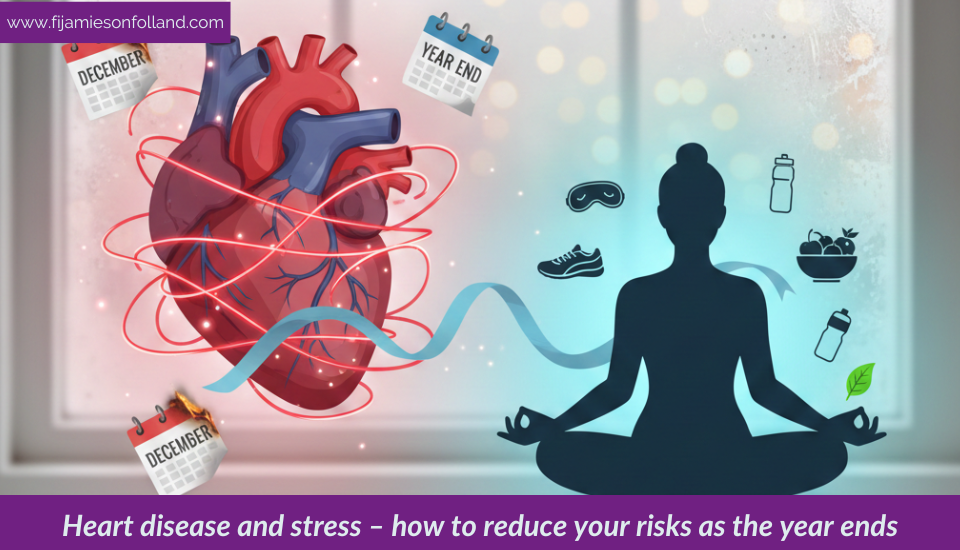
As the year draws to a close, there’s this strange mix of excitement, fatigue, reflection, and, for some (more than we may think), a deep undercurrent of stress that runs quietly beneath the surface.
You might feel it too — that pressure to finish strong at work, to plan the holidays, to show up for family, to tie up the loose ends that somehow never really feel finished. And amid all this bustling, your heart, that loyal, tireless muscle inside your chest, is working overtime — both literally and emotionally. Because the truth is, your heart feels it all.
This time of year, stress levels tend to peak, and so does the risk of heart events. Hospitals consistently report more heart attacks during the holiday months, especially around December and January. It’s not just about the increased pace and higher temps in southern climbs, or the colder weather in the northern hemisphere — it’s about the way we push ourselves mentally and physically, how we eat differently, move less, and sleep worse, all while juggling the emotional weight of the season. So if there’s ever been a moment to pause, breathe, and pay attention to your heart health, it’s right now.
It’s time to address what’s really happening — the connection between stress and heart disease, why the year-end period makes it worse, and how you can protect yourself with small, thoughtful changes that carry you into the new year with a calmer mind and a stronger, steadier heart.
The invisible link between stress and your heart
Your heart doesn’t just respond to physical activity; it responds to your emotional landscape too. When you’re stressed, your body enters what’s known as the ‘fight or flight’ response — an ancient survival mechanism meant to protect you from immediate danger. Hormones including cortisol and adrenaline flood your bloodstream, raising your heart rate and blood pressure, tightening your blood vessels, and preparing your muscles for action.
This is perfectly fine and normal in short bursts — like when you’re running late or facing a sudden challenge. However when stress becomes chronic, as it often does toward the end of the year, this response never fully shuts off.
Your heart stays in a low-grade state of alert.
Over time, that continuous pressure contributes to inflammation, arterial stiffness, elevated blood sugar, and even the build up of plaque in your arteries.
In simpler terms — long-term stress subtly reshapes your heart’s environment, making it more vulnerable to disease. It’s not dramatic or instant, rather it’s insidious and powerful.
And what’s particularly dangerous is that many people don’t notice it happening. They just feel ‘tired,’ ‘on edge,’ or ‘burned out,’ not realising that their cardiovascular system is quietly bearing the weight of their emotional state.
Why year-end stress hits harder
There’s a certain irony about the end of the year — it’s supposed to be joyful, filled with celebration and connection, whereas in fact for so many, it’s one of the most stressful times of all. There are deadlines to meet, social obligations to juggle, financial pressures that flare up, and often, family dynamics that stir old emotions. The length of the days are at their extremes (either at their longest or shortest)…
…our routines fall apart
…we eat differently — more sugar, more salt, more alcohol
… and we sleep less.
All of these small changes combine to create the perfect storm for heart stress. For those in the northern hemisphere, the lack of sunlight affects serotonin levels, lowering mood and increasing fatigue. The extra sodium and alcohol cause water retention and blood pressure spikes. And the emotional load — whether it’s loneliness, loss, or the weight of expectations — triggers those same physiological stress responses that overwork your heart.
Even joy can be stressful, in a way. The travel, the planning, the endless to-do lists — it all takes energy, and when that energy runs low, your body compensates by releasing more stress hormones. By the time January rolls around, many people are physically depleted, emotionally exhausted, and wondering why they feel so drained.
The answer often lies in how much the heart has been carrying.
The emotional side of heart disease
We often think of heart disease as something purely physical — arteries clogging, blood pressure rising, cholesterol accumulating. However emotions are powerful contributors. Studies consistently show that chronic stress, anxiety, depression, and even feelings of isolation can increase the risk of heart disease and poor recovery after cardiac events.
Emotional distress changes how your body handles inflammation and blood clotting. It influences how much you sleep, what you eat, how much you move, and whether you take time to rest. It can even alter the balance of your gut microbiome, which researchers now know plays a surprising role in cardiovascular health.
As a heart-healthy coach, I’ve come across this a lot — those who are doing ‘everything right’ physically, eating well, exercising, taking their Nutritionals — whilst running on emotional fumes. Stress levels are quietly undoing the good work their bodies are attemping to do.
It makes sense that part of healing your heart isn’t just about diet or exercise. It’s about creating emotional conditions where your heart can truly relax.
When stress shows up in your body
Your body has a way of whispering before it shouts. You might notice signs of chronic stress without realising what they mean. Things like tension headaches, digestive issues, restless sleep, or irritability. Maybe your chest feels tight, your heart beats a little faster than usual, or you find yourself short of breath even without much exertion. These are all signals — your heart asking for a pause.
During the holidays, these whispers can easily get drowned out by busyness. You might blame fatigue on long days, headaches on screens, or poor sleep on too much coffee — however underneath it, your body could be waving a quiet flag, saying – ‘slow down.’
The good news is, once you recognise these signs, you can act before they escalate. Awareness is the first form of prevention.
How stress influences your heart physically
Let’s get practical for a moment. Stress doesn’t just feel uncomfortable; it changes your internal chemistry in ways that directly impact heart function. Elevated cortisol raises blood sugar levels, which over time contributes to insulin resistance — one of the precursors to metabolic syndrome and cardiovascular disease. Adrenaline causes your blood vessels to constrict, increasing blood pressure and making your heart work harder.
Chronic stress also lowers your body’s levels of nitric oxide — a compound that helps your blood vessels relax and stay flexible. Less nitric oxide means stiffer arteries, higher pressure, and greater wear and tear on your vessel walls. This combination creates an environment ripe for atherosclerosis — the build up of fatty deposits that narrow your arteries.
Yet here’s the remarkable thing – these processes are reversible. When you lower your stress levels, your body responds.
Blood pressure drops.
Inflammation subsides.
Arteries regain flexibility.
Your heart rate variability — a key marker of cardiovascular resilience — improves.
It’s like your heart exhales in relief.
The lifestyle patterns that quietly increase year-end risk
We tend to underestimate how much our routines change in November and December. The days adjust in length – and either get longer or shorter, so we move a lot more, or a lot less. We attend gatherings where food choices lean rich and indulgent. We stay up later, drink more, skip workouts, and tell ourselves we’ll ‘start fresh in January.’
These shifts add up. Reduced activity lowers your good HDL cholesterol, while poor sleep raises your triglycerides and appetite hormones. Add in dehydration from alcohol and caffeine, and your blood becomes thicker and more prone to clotting. Combine that with emotional stress and cold weather (in northern climbs) — both of which constrict blood vessels — and it’s easy to see why this season brings more cardiac emergencies.
However – awareness gives you power. When you see the pattern, you can gently interrupt it. You can keep moving even when it’s cold, or find a way to keep cooler and move in warmer parts of the globe. You can choose water between glasses of alcohol. You can prioritise sleep like the essential heart medicine it truly is.
Reconnecting with your breath
One of the simplest and most underrated ways to protect your heart from stress is through breath. 1
Slow, intentional breathing activates your parasympathetic nervous system — the part responsible for calm and recovery. When you take long, steady breaths, you’re literally telling your body, ‘I’m safe.’
Your heart rate slows. Your blood pressure drops. Your stress hormones quiet down.
You don’t need a long meditation practice to benefit. Try taking just five slow breaths before you answer an email, start your car, or walk into a meeting. Breathe in through your nose for a count of four, hold for one, and exhale through your mouth for six. This simple rhythm encourages your heart to find its natural, healthy beat again.
Over time, this becomes a reflex. Your body learns to recover more quickly from stress instead of staying trapped in it.
Rest, recovery, and the heart’s need for stillness
We often glorify productivity, especially at year’s end — the finishing, the achieving, the doing.
However your heart needs the opposite sometimes. It needs stillness. It thrives in the moments when you let yourself rest without guilt.
Sleep is one of the most healing tools you have. During deep sleep, your body lowers blood pressure, repairs cells, and balances hormones. It’s also when your heart learns to ‘rest and reset.’ Missing out on this recovery night after night can slowly elevate risk. So this season, consider giving yourself the gift of boundaries — less screen time at night, earlier wind-down routines, and perhaps a promise to stop multitasking your rest.
Rest isn’t laziness. It’s biology. It’s heart protection.
Nourishing your heart through mindful eating
Food during the holidays is emotional — it’s culture, connection, comfort. And it should be. You don’t have to restrict yourself to be healthy. What matters more is how you eat, not just what you eat.
When you eat in a calm state — not rushed, not distracted — your digestion improves, your metabolism functions more smoothly, and your blood sugar stays steadier. Stress eating, on the other hand, disrupts all of that.
Trial slowing down. Put your fork down between bites. Notice flavours. Choose foods that make you feel energised rather than sluggish — more colour on the plate, more fibre, less refined sugar.
And hydrate. Water helps your blood flow freely, supports kidney function, and assists in regulating temperature and circulation. Even mild dehydration thickens the blood slightly, which adds unnecessary work for your heart.
Movement as medicine — even in small doses
The colder months can make it tempting to curl up and skip exercise, however movement doesn’t have to mean intensity. A brisk walk after meals, stretching before bed, or even light yoga can dramatically improve circulation and mood. Exercise reduces stress hormones and increases endorphins — nature’s built-in mood stabilizers.
When you move, you help your body process stress physically, rather than letting it sit as tension. Your heart grows stronger, your blood vessels stay flexible, and your overall sense of vitality improves. Think of it as giving your heart a rhythm to dance to — one that’s steady and kind.
Creating emotional balance as the year ends
This season invites reflection — what went well, what didn’t, what you wish had been different. Reflection is healthy, however rumination/stewing is not. It’s easy to slip from gratitude into guilt or comparison. The way you speak to yourself matters here. Self-compassion has measurable effects on heart health, lowering inflammation and supporting hormonal balance.
Maybe you didn’t eat perfectly this year, or maybe you skipped more workouts than you intended — that’s ok. What’s healing for your heart right now is to forgive yourself and start again gently.
Emotional calm is not about perfection; it’s about perspective.
Looking ahead with intention
As you close out the year, consider setting intentions that nurture your heart rather than punish it. Instead of resolutions about restriction — ‘no sugar,’ ‘lose weight,’ ‘run every day’ — focus on rhythms that bring joy and steadiness.
‘I’m moving every day in a way that feels good.’
‘I’m prioritising rest.’
‘I’m managing stress before it manages me.’
These kinds of commitments stick because they’re rooted in care, not criticism. And that’s the foundation of heart health — consistent care, season after season.
A final reflection – your heart deserves peace too
When you think about heart disease, it’s easy to focus on cholesterol and blood pressure, however your heart is far more than a pump.
It’s an emotional organ. It listens to your stress, your sleep, your breath, your thoughts. As the year ends, it deserves the same compassion you offer everyone else.
So take a quiet moment.
Sit still.
Feel your heartbeat — that steady rhythm that’s been with you through every challenge, every joy, every long day and late night.
Let that sound remind you that you’re alive, that you have the power to choose calm, to choose balance, to choose health.
Reducing your risk isn’t just about avoiding disease — it’s about creating a life your heart feels safe in.
See you on this week’s #AlivewithFi 🙂
Fi Jamieson-Folland D.O., I.N.H.C., is The LifeStyle Aligner. She’s an experienced practitioner since 1992 in Europe, Asia and New Zealand as a qualified Osteopath, Integrative Nutrition Health Coach, speaker, educator, writer, certified raw vegan gluten-free chef, and Health Brand Ambassador.

Facebook Instagram LinkedIn Pinterest YouTube
1 Deep breathing exercise at work – Potential applications and impact (National Library of Medicine)
–
https -//pmc.ncbi.nlm.nih.gov/articles/PMC9877284/