
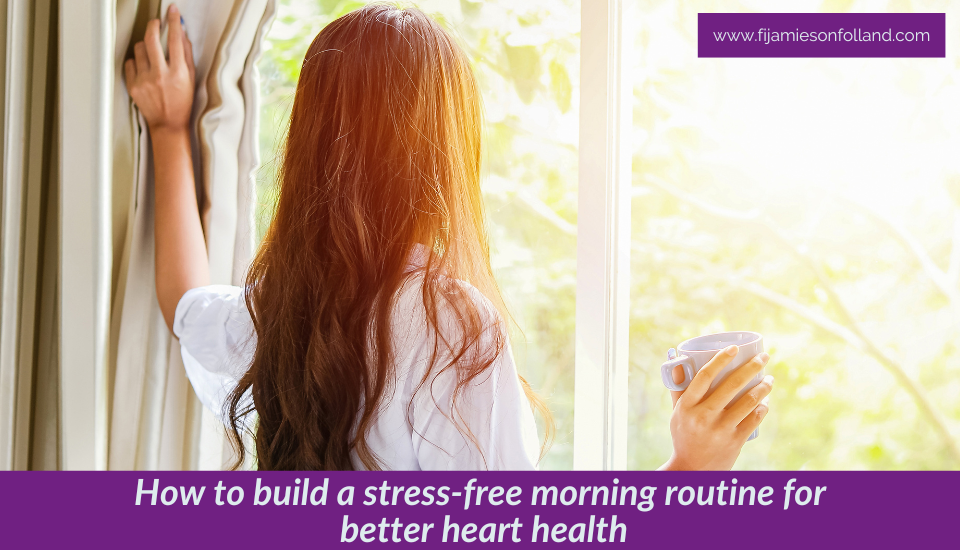
Mornings have a certain power, don’t they?
The way you begin your day often sets the rhythm for everything that follows, and if you’ve ever started out frazzled—spilling coffee, running late, snapping at traffic or loved ones—you know how challenging it can be to recover your calm later. For those of us who care deeply about heart health, mornings become even more important because stress hormones surge when we wake, our blood pressure naturally rises, and our choices in those first hours either soothe our cardiovascular system or load it with unnecessary strain. 1
I’ve lived this in my own body—decades ago, when doctors told me that my genetic heart condition meant I wouldn’t live past twenty-four without medication, I realised quickly that how I structured my mornings mattered far more than any prescription alone. Rushing, worrying, skipping breakfast, and starting the day on adrenaline made me feel like my heart was carrying bricks. However, when I began to craft mornings that honoured peace, nourishment, and movement, something shifted—I wasn’t just surviving; I was thriving, and my heart felt like it was working with me rather than against me.
So today, let’s explore how to build a stress-free morning routine that protects your heart, calms your mind, and leaves you walking into the day with a sense of grounded confidence instead of a racing pulse. And I promise—we’re going to keep things fresh, practical, and realistic, because life can be messy, and you deserve ideas that flex with real mornings, not some perfect social media post fantasy.
Why mornings are a stress tipping point
Let’s start with biology.
The moment you wake, your body experiences what’s called the ‘cortisol awakening response.’ Cortisol, our primary stress hormone, naturally spikes to help us get up and alert. Now, a healthy rise is good—it motivates us; however, if we pile on rushing, scrolling through bad news, or skipping nourishment, cortisol skyrockets, blood vessels constrict, and our heart works harder than it should before we’ve even brushed our teeth.
Add in caffeine on an empty stomach or arguments with loved ones in the kitchen, and suddenly your morning is a perfect storm for elevated blood pressure and tension that ripples through your whole day.
This is why building a stress-free morning isn’t about perfection—it’s about gently lowering those early stress surges and choosing rhythms that steady the heart instead of shocking it awake.
The night before sets the tone
I know this might sound like cheating—starting the morning routine the night before—however, it seems to be the ‘secret’ nobody talks about. Stress-free mornings are born out of peaceful evenings.
Think about it – if you’re scrolling at midnight, eating heavy food late, or watching that cliff-hanger episode that spikes your adrenaline, you’re sabotaging tomorrow. Your sleep becomes shallow, and you wake already tired. No amount of lemon water or yoga can fix a body that hasn’t rested.
So here’s one shift to consider – create a gentle evening wind-down. It doesn’t need to be elaborate. Maybe laying out your clothes, jotting tomorrow’s top three priorities in a notebook, or switching to candlelight half an hour before bed. These tiny shifts tell your body ‘we’re safe, we’re slowing down, we’re ready for repair.’ And this repair, by the way, is where your heart rejuvenates. Sleep lowers blood pressure, balances hormones, and repairs arteries. Without it, mornings are uphill battles.
Awakening without shock
Do you wake to a blaring alarm that jolts you out of a dream like a fire drill? That single habit can set your nervous system into panic mode before your feet hit the floor.
Instead, trial waking gently. Natural light alarms, soft chimes, or even just placing your phone across the room so you rise to turn it off calmly rather than snooze in stress, can transform the first 60 seconds. You might want to trial whispering a positive word to yourself the moment you wake—for example,’ ease,’ or ‘strength,’ or ‘gratitude.’ It sounds small, however, our subconscious listens.
And if you wake with anxiety about the day ahead, pause before grabbing your phone. Place your hand over your heart, breathe deeply three times, and remind your body that it is safe. Those first breaths anchor your nervous system in calm.
Hydration before stimulation
Most people reach for coffee first thing. I get it—I love my green tea—however, here’s the catch – your body is dehydrated after sleep, your blood is thicker, and your heart is pumping that thicker blood through your system. If you add caffeine on top without water, you can increase strain unnecessarily.
So, the golden rule – water first, coffee second. A glass of water with a squeeze of lemon not only hydrates, it also gently wakes your digestion – your heart will thank you.
Movement that energises without depleting
Here’s where I like to put a question mark beside the ‘no pain, no gain’ mentality. You do not need a sweaty, exhausting workout first thing in the morning to protect your heart. In fact, intense exercise on an empty stomach can sometimes elevate stress hormones more than it helps.
What works better? Gentle yet consistent movement.
Think –
- A 10-30 minute walk outside while noticing nature around you
- Simple stretches while music plays in the background
- Qi Gong or yoga flows designed to open the chest and expand our breath
- Dancing in your kitchen while your tea brews—yes, seriously
The aim is circulation, not exhaustion. Movement that leaves you refreshed, not drained, sets the tone for a day where your cardiovascular system stays balanced.
Breakfast as heart nourishment, not a sugar crash
Skipping breakfast or grabbing a pastry loaded with sugar and fat is a sure way to spike insulin, then crash, leaving your heart racing as your body plays catch-up.
Instead, think in terms of balance – protein + fibre + healthy fats.
For example –
- Live coconut yogurt with berries and walnuts.
- Avocado on whole-grain toast with a spoon of pre-soaked + rinsed pumpkin seeds.
- A smoothie with spinach, banana, tahini, and pre-soaked flaxseeds.
These kinds of breakfasts stabilise blood sugar, lower inflammation, and give your heart the nutrients it craves to stay strong. And remember, a calm digestive system equals a calm heart—because the gut-heart connection is real.
Guarding your mental space
One of the most underestimated parts of a stress-free morning routine is protecting your mind from immediate bombardment. If the first thing you do is scroll through emails or headlines, you’ve basically invited chaos to breakfast.
Instead, set boundaries. Maybe you give yourself 20–30 minutes before screens. Use that time to journal a few thoughts, read something inspiring, or simply look out the window and let your mind wander.
Personally, I love making a note of 5 things I’m grateful for and one intention for the day, and a post this in a gratitude I’ve been a part of since 2018.
It doesn’t need to be profound—sometimes my gratitude is just ‘the smell of fresh herbs’ or ‘the neighbour’s dog greeting me on my morning walk.’ Know that gratitude shifts our physiology, lowering cortisol and increasing serotonin, which creates resilience for our hearts.
Breathing practices to reset your heart rhythm
Breath is free, portable, and immediate. And yet, most of us can sometimes forget its power. One of my favourite techniques is 3, 10, 10 breathing—inhale for 3 counts, hold for 8 counts, exhale for 10 counts, repeat for 5 minutes. This synchronises your breath with your heart rate variability, calming the nervous system and literally training your heart to beat more efficiently.
If you want variety, trial ‘box breathing’—inhale 4, hold 4, exhale 4, hold 4—or simply sigh audibly from your mouth, letting tension melt out of your chest. Even two minutes of conscious breathing can lower blood pressure.
Choosing your rhythm instead of rushing
The truth is, you can build the most beautiful morning routine, however if you oversleep and rush out the door, it crumbles. So, a practical tip – reverse-engineer your wake-up time from your commitments. If you need to leave by 8 and want an hour of calm routine, wake at 7—not 7:30.
Yes, it means earlier nights, however that’s part of treating your heart with respect. And here’s a shift in mindset – rather than seeing it as ‘sacrificing sleep,’ see it as ‘securing peace.’ That extra 20–30 minutes in the morning buys you calm that ripples through your entire cardiovascular system for the day.
Adding variety so mornings don’t feel rigid
Here’s where people often stumble—they create a routine so strict that it becomes stressful if they miss a step. Remember, the goal is not perfection, instead it’s consistency and adaptability.
You don’t need to meditate every morning if it feels forced. Some days your meditation could be chopping fruit mindfully. Some days your exercise could be walking your dog. Some mornings, laughter with your partner is as healing as any yoga pose.
The key is weaving principles—hydration, nourishment, movement, calm—into whatever form feels right that day. That flexibility prevents stress about the routine itself.
Handling mornings that go wrong
Let’s be honest, not every morning will be serene. Car challenges happen, kids get sick, alarms fail, traffic looms. The ‘secret’ is resilience. If you oversleep, don’t throw the whole routine out. Choose one anchor habit—a quick glass of water, 60 seconds of breath, or one nutritious snack to take with you. Anchors keep us tethered to calm, even when the storm hits.
This mindset—doing something rather than nothing—protects your heart from the all-or-nothing stress trap.
Integrating joy
We talk so much about discipline that we forget joy. What if your morning included something that made you smile, not just something that made you ‘healthy’? Joy is medicine for the heart.
It might be music that makes you dance, a walk in nature, a voice note message to a friend across the world, reading poetry, or sitting in peaceful silence with a candle. When joy enters your morning, stress loses its grip, and your heart rhythm literally reflects that ease.
Conclusion – mornings as heart protection rituals
A stress-free morning routine isn’t about creating some idealised version of life where you sip green juice by a sunlit window every day. It’s about designing rhythms that steady your nervous system, nourish your body, and give your heart the calm start it needs to carry you through the day.
When I look back at my journey—from the terrified twenty-one-year-old who thought her heart might fail at any minute to the woman in her fifties (at the time of writing!) now thriving—I see clearly that mornings were very much a key part of where the shift happened. Each day, I had a choice – to start with chaos or with care. And over time, those choices are stacking up into resilience, vitality, and a sense of partnership with my own body.
So here’s my invitation to you – choose one small shift this week.
Maybe it’s water before coffee.
Maybe it’s five minutes of breathing.
Maybe it’s simply putting your phone aside for the first half hour.
And notice—truly notice—how your heart responds.
Because your heart is listening. And when you gift it calm in the morning, it will gift you strength the rest of the day.
See you on this week’s #AlivewithFi 🙂
Fi Jamieson-Folland D.O., I.N.H.C., is The LifeStyle Aligner. She’s an experienced practitioner since 1992 in Europe, Asia and New Zealand as a qualified Osteopath, Integrative Nutrition Health Coach, speaker, educator, writer, certified raw vegan gluten-free chef, and Health Brand Ambassador.

Facebook Instagram LinkedIn Pinterest YouTube
1 Morning activity reduces CVD risk by 16%, worth a read – https -//pubmed.ncbi.nlm.nih.gov/36372091/