
There is a moment that many of my clients describe to me — and I’m willing to bet you’ve had some version of it yourself — where you become suddenly, vividly aware of your own heartbeat in a way that catches you off guard, either because it’s racing when you’d rather it wasn’t, or because you’ve found yourself pressing your fingers to your wrist in a quiet moment and marvelling at this steady, faithful drumbeat that has been working tirelessly for you since before you even drew your first breath.
The heart is extraordinary in its dedication, and the research connecting our mental and emotional lives to our cardiovascular health is now so robust, so layered, and so genuinely fascinating that I find myself revisiting it often — because understanding it changes the way you approach not just ‘stress management’ – it actually changes your whole relationship with the present moment.
Mindfulness — which in its simplest, most stripped-back form means paying deliberate, non-judgemental attention to your present-moment experience — has moved a long way from its origins as a niche wellness concept into the mainstream of cardiovascular research, and the evidence that has accumulated around what regular mindfulness practice does to the stressed heart is both scientifically compelling and deeply human.
This blog is my attempt to walk you through that evidence, to introduce you to specific mindfulness exercises that have real cardiovascular relevance, and to help you understand not just what to do; it’s to really get why it works — because I genuinely believe that when you understand the mechanism, the practice becomes more meaningful, more sustainable, and more yours.
What stress does to the heart, and why mindfulness is not a soft option
Before we get into the exercises themselves, I want to spend a little time on the physiology — because ‘mindfulness is good for stress’ can sound like something you’d read on a motivational poster, and I want you to understand that we’re talking about measurable, documentable, clinically significant changes happening at the level of your autonomic nervous system, your arterial walls, your inflammatory pathways, and your heart’s electrical patterning.
Chronic psychological stress activates the sympathetic branch of your autonomic nervous system — the fight-or-flight arm — in a way that keeps cortisol and adrenaline circulating at elevated levels for prolonged periods, which drives up blood pressure, promotes arterial stiffness, increases inflammatory markers like C-reactive protein and interleukin-6, and disrupts the rhythmic coherence of the heart’s electrical activity in ways that have real and lasting consequences for cardiovascular health.
Heart rate variability — often abbreviated to HRV — is one of the most sensitive and revealing measures of how well your autonomic nervous system is functioning, and it has become something of a gold standard in cardiovascular stress research over the past two decades. High HRV means your heart is beating with a healthy, flexible, responsive variability between beats, which reflects robust parasympathetic (rest-and-digest) tone and good autonomic balance — and it is associated with lower cardiovascular risk, better emotional regulation, greater cognitive flexibility, and improved resilience to stress.
Low HRV, by contrast, is associated with higher cardiovascular mortality, poorer stress recovery, and increased risk of arrhythmias.
Mindfulness practice, as we’ll explore, has a direct and measurable effect on HRV — and that is not a small thing.
Mindful breathing – the simplest entry point with the deepest cardiovascular roots
If you were to ask me which mindfulness practice to start with if you’ve never done any before, my reply is mindful breathing without hesitation — not because it’s the easiest (though it is accessible) – it’s because the relationship between conscious, regulated breathing and cardiovascular function is so direct and so well-evidenced that even a few minutes of it produces measurable physiological shifts.
When you slow your breathing deliberately — aiming for somewhere around five to six breath cycles per minute, which is slower than most of us breathe habitually — you engage something called the baroreflex, a feedback mechanism in your cardiovascular system that uses the rhythm of your breath to regulate heart rate and blood pressure, and at this slower respiratory rate the synchronisation between your breathing and your heart rate reaches a kind of optimal coherence that is deeply regulating to the nervous system.
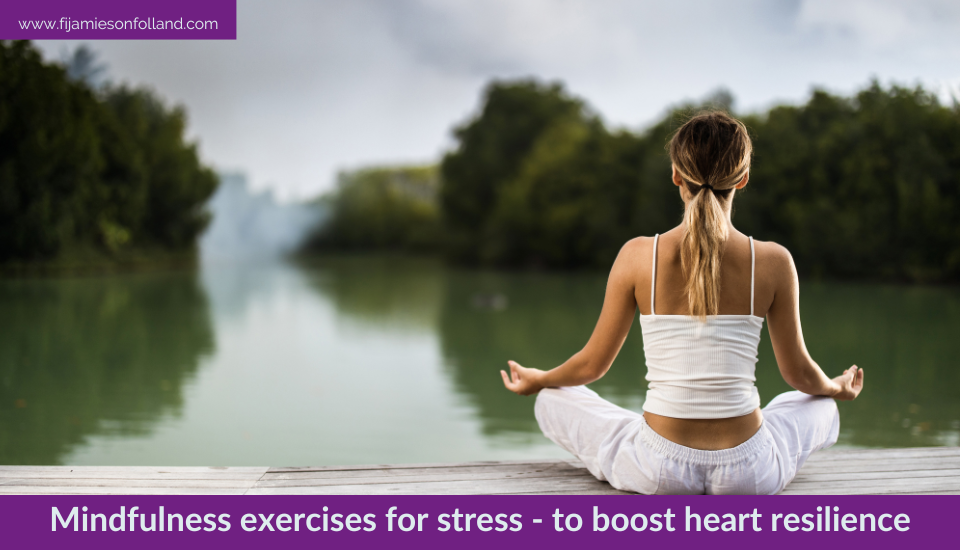
To practise mindful breathing in a way that genuinely serves the heart, find a comfortable seated position and bring your attention to the natural rhythm of your breath without trying to change it at first — just noticing the sensation of air entering through your nostrils, the slight expansion of your chest or belly, and the release of the exhale. Then, gradually, begin to lengthen the exhale so that it is slightly longer than the inhale — breathing in for a count of four or five, and out for a count of six or seven — because it is the extended exhale that most powerfully activates the vagus nerve and the parasympathetic response.
The quality of attention here matters as much as the mechanics – when your mind wanders (and it will, because that is what minds do), the practice is simply in noticing that it has wandered and gently returning, without frustration, without self-criticism — and that act of returning, repeated over and over, is the neurological training that makes mindfulness so transformative over time.
The body scan – a practice of radical self-listening
The body scan is one of the foundational practices of Mindfulness-Based Stress Reduction (MBSR), originally from the eight-week programme developed by Jon Kabat-Zinn at the University of Massachusetts that has seemingly become one of the most extensively researched mindfulness programmes in the world — and it is, in essence, a slow, deliberate, non-judgemental journey of attention through the body, from the soles of the feet to the crown of the head, noticing sensation, tension, temperature, and the quality of aliveness in each region without any agenda to change or fix what you find there.
What sounds simple is in practice quite profound, particularly for people who have spent years living largely from the neck up, treating the body as a vehicle to be managed rather than a living system to be listened to.
From a cardiovascular perspective, the body scan matters for several reasons, not least because chronic stress tends to produce patterns of muscular holding and tension — particularly in the shoulders, jaw, neck, and chest — that contribute to elevated sympathetic nervous system tone in a kind of feedback loop, where the tension signals danger to the brain, which maintains the stress response, which maintains the tension.
By bringing gentle, curious, non-reactive awareness to these held tensions, the body scan interrupts that loop and allows the nervous system to begin to release its vigilance. The practice also cultivates a quality of interoceptive awareness — the ability to accurately perceive the internal state of your body — that is increasingly understood to be a key component of emotional regulation and stress resilience, and that has direct relevance to how we respond to and recover from cardiovascular stress. Even a twenty-minute body scan practised three or four times per week has been shown in MBSR research to produce significant reductions in perceived stress, improved sleep quality, and measurable improvements in autonomic nervous system regulation over an eight-week period.
Mindfulness and heart rate variability – what the science actually shows
This is the section I find most exciting to share, because the science here is genuinely impressive and getting more so with every well-designed study that comes out — and it’s time to ground the whole conversation in something concrete and rigorously tested.
Heart rate variability, as I mentioned earlier, is the measure that gives us the clearest window into how mindfulness is affecting the heart’s autonomic regulation, and the research findings are striking.
A fully randomised controlled trial conducted by Kirk and Axelsen at the University of Southern Denmark 1 measured HRV continuously across a ten-day online-based mindfulness intervention, comparing participants who practised daily mindfulness against both an active control group (music listening) and a non-intervention control. The mindfulness group showed significant improvements in HRV not only during their practice sessions, it was also — crucially — in both their daytime and night time HRV measured during periods when they were not formally practising, indicating that the effects were being carried into everyday life and into sleep quality in a way that the music control group’s results did not replicate. This suggests that mindfulness practice produces genuine, lasting cardiovascular adaptation rather than just an in-the-moment relaxation effect.
What this means practically is that even a brief, consistent daily mindfulness practice — in this study just ten to thirty minutes per day over ten days — is enough to produce measurable cardiovascular changes in people who have never meditated before, which is one of the most encouraging findings in this literature for those who are new to the practice and wondering whether it’s worth investing the time. The improvements in night time HRV are particularly significant from a heart health perspective, because the quality of autonomic regulation during sleep is one of the strongest predictors of long-term cardiovascular resilience, and the fact that mindfulness practice appears to enhance it even in complete beginners is genuinely remarkable.
Loving-kindness meditation and the surprising cardiology of compassion
Loving-kindness meditation — known in the Buddhist contemplative tradition as metta — is a practice that can raise eyebrows when it’s introduced in a heart health context, because it sounds almost too soft, too gentle, too far removed from the world of cardiovascular risk markers and autonomic function to be taken seriously as a clinical intervention.
And yet the research behind it, particularly in relation to inflammatory biology and the parasympathetic nervous system, is quietly extraordinary. The practice involves the deliberate cultivation of warm, compassionate feelings — first towards oneself, then extending outward to loved ones, to neutral people, to difficult people, and ultimately to all living beings — using phrases like ‘may you be happy, may you be healthy, may you be safe, may you live with ease’ as anchors for the emotional quality being cultivated.
What loving-kindness practice does to the cardiovascular system operates through several pathways that we understand better now than even a decade ago. Firstly, the activation of genuine warmth and compassion engages the ventral vagal complex — the evolutionarily newer branch of the vagus nerve associated with social engagement, safety, and parasympathetic calm — in a way that measurably increases heart rate variability and reduces sympathetic arousal.
Secondly, studies have shown that regular loving-kindness practice reduces circulating levels of inflammatory markers including interleukin-6 and C-reactive protein, both of which are directly relevant to arterial health and cardiovascular risk.
Thirdly, and perhaps most interestingly, it appears to reduce the physiological stress response to difficult social interactions — meaning that the moments in daily life that tend to spike cortisol and blood pressure most dramatically, which are often interpersonal conflicts and social threats, begin to have a less severe cardiovascular impact in people who practise loving-kindness regularly. That is a meaningful benefit in a world where relational stress is one of the most pervasive sources of chronic cardiovascular burden.
Mindful movement – yoga, tai chi, and the meditative heart
There is a category of mindfulness practice that lives in the body rather than in seated stillness, and for many people — particularly those who find formal sitting meditation difficult to sustain — it offers one of the most accessible and cardiovascularly potent entry points into the whole process.
Yoga, in its slower, more breath-integrated forms — hatha, yin, restorative — combines the deliberate regulation of breath with gentle movement and present-moment sensory awareness in a way that has a well-documented and meaningful effect on the autonomic nervous system, blood pressure, and inflammatory markers.
Tai chi, the slow-moving Chinese martial art that has been practised for centuries as both meditation and medicine, has one of the richest evidence bases of any mind-body practice for cardiovascular benefit, with multiple meta-analyses showing significant reductions in systolic and diastolic blood pressure, improvements in lipid profiles, and enhanced vagal tone in older adults — a population where cardiovascular resilience is particularly important and often particularly compromised.
What distinguishes these practices from ordinary gentle exercise is the quality of attentional engagement they require — the fact that you cannot effectively do tai chi or flow-based yoga while mentally composing your shopping list or running through tomorrow’s agenda, because the practice demands a continuous, embodied present-moment awareness that functions as mindfulness in motion. This means that the cardiovascular benefits of the physical movement and the neurological benefits of the mindfulness practice are happening simultaneously and synergistically, which may explain why studies consistently show these practices producing cardiovascular effects that exceed what would be expected from the physical exertion alone.
For people who are new to mindfulness and find the idea of sitting quietly with their thoughts genuinely uncomfortable, starting with mindful movement can be a beautifully low-barrier way to discover that the practice is less about achieving a blank mind and more about learning to inhabit your experience with a different quality of attention.
Open monitoring meditation and the art of watching thought without being consumed by it
Focused attention practices — like mindful breathing, where you anchor your attention to a single object and return to it when the mind wanders — are the most widely taught form of mindfulness and an excellent starting point, although there is another category of practice called open monitoring meditation that deserves its own place in the heart resilience toolkit, particularly for people dealing with the kind of ruminative, circular thinking that is one of the most physiologically costly features of chronic stress.
In open monitoring, rather than anchoring attention to a specific object, you cultivate a broad, receptive, panoramic awareness of whatever arises in your experience — thoughts, feelings, sensations, sounds — without getting pulled into any of it, treating each arising as a passing event in the field of awareness rather than something that needs to be engaged with, solved, or resisted.
The cardiovascular relevance of this practice lies in its effect on rumination — the tendency to replay stressful events, replay difficult conversations, anticipate future threats, and generally keep the stress response activated long after the original stressor has passed. Rumination is one of the most physiologically expensive cognitive habits a person can have, because it essentially tricks the body into treating imagined threats as real ones, maintaining cortisol and sympathetic nervous system activation in the absence of any actual danger.
Open monitoring practice, over time, tends to loosen the grip of rumination significantly — not by suppressing or avoiding difficult thoughts, instead by changing your relationship to them, creating a quality of witnessing space around them that reduces their capacity to hijack the nervous system. This is a more advanced practice than focused attention, and for most people it develops naturally through sustained engagement with the simpler practices first — although its effects on the kind of chronic, story-driven stress that does so much cardiovascular damage are genuinely impressive.
Building a daily practice that your heart will actually thank you for
The question I get asked most often after introducing someone to mindfulness in a coaching context is not ‘does it work?’ — because by the time we’ve had that conversation, the research usually answers that — although ‘how do I actually build a habit of it when my life is already so full?’
Because the gap between knowing something is good for you and actually doing it consistently is where so many well-intentioned wellness intentions go to die – there is a real art to building a sustainable mindfulness practice that doesn’t require a personality transplant or a dramatically different life to sustain.
The most important principle is this – consistency at a small dose is vastly more valuable than occasional heroic sessions, because it is the daily, repeated activation of the parasympathetic nervous system that gradually trains the autonomic nervous system toward a healthier baseline — and even five minutes of genuine, attentive mindful breathing every morning is enough to begin that training if done consistently.
The second principle is integration rather than addition — finding ways to bring mindful attention into activities you’re already doing rather than treating mindfulness as a separate task that must be squeezed into an already overfull schedule. The morning shower becomes a practice in sensory presence; the commute becomes an opportunity for mindful breathing rather than anxious planning; the first sip of coffee becomes a moment of genuine sensory attention rather than an automatic reflex.
These micro-practices don’t replace a dedicated formal practice, although they build the neural momentum that makes a formal practice feel less effortful and more natural over time. And for the formal practice, I’d encourage you to start with what feels manageable — even five to ten minutes using a guided audio or an app — and build from there as the practice becomes part of your identity rather than an item on your to-do list. Your heart is not asking you to become a monk; it’s asking you to show up, consistently and with genuine attention, for the few minutes a day that might quite literally be the difference between a heart that ages with resilience and one that carries the accumulated weight of unaddressed stress.
A word on self-compassion as the foundation of everything
It’s worth closing with something that doesn’t always make it into the research papers – which is that the quality that most reliably predicts whether someone’s mindfulness practice will actually take root and transform their relationship with stress is not discipline, not willpower, not even natural aptitude for stillness — it is self-compassion.
The ability to turn towards your own experience with kindness rather than harsh judgement, to recognise that struggling with stress and with the practice itself is part of being human rather than evidence of personal failure, to treat yourself with the same warmth you would offer a dear friend who was finding things difficult. Self-compassion is not self-indulgence or passivity — the research, most extensively by psychologist Kristin Neff, shows it is associated with greater motivation, more effective coping, lower levels of anxiety and depression, and — directly relevant to what we’ve been talking about here — significantly better physiological stress regulation, including lower cortisol and more adaptive autonomic responses.
The moments when you miss your practice, when you sit down to meditate and spend the whole time planning dinner, when the stress gets loud and the parasympathetic system seems very far away — those moments are not setbacks, they are the practice.
Resilience, for the heart as for the human, is not the absence of difficulty.
The capacity to return — to the breath, to the present moment, to yourself — with patience and without drama, again and again and again.
That returning is the whole thing, and your heart knows how to meet you there.
See you on this week’s #AlivewithFi ☺
Fi Jamieson-Folland D.O., I.N.H.C., is The LifeStyle Aligner. She’s an experienced practitioner since 1992 in Europe, Asia and New Zealand as a qualified Osteopath, Integrative Nutrition Health Coach, speaker, educator, writer, certified raw vegan gluten-free chef, and Health Brand Ambassador.

Facebook Instagram LinkedIn Pinterest YouTube
1 Research reference – ‘Heart rate variability is enhanced during mindfulness practice – A randomised controlled trial involving a 10-day online-based mindfulness intervention’ — Kirk U & Axelsen JL, PLoS One, December 2020. PMID – 33332403 – https -//pubmed.ncbi.nlm.nih.gov/33332403/