When most people think about heart disease, the very first image that comes to mind is physical—the arteries narrowing, the chest tightening, the primary healthcare practitioner explaining numbers and risk factors.
However, what often gets pushed into the background, or forgotten completely, is the psychological impact that follows like a shadow, because when your heart is under threat, your mind doesn’t stay untouched; it wrestles with fear, uncertainty, and even shame, and sometimes those invisible battles can be the heaviest of all.
I know this because I’ve lived it—not just through my experience with my father, who died suddenly of a heart attack at fifty when I was only twenty-one, but also through my own journey, when primary healthcare practitioners told me my genetics meant I wouldn’t live past twenty-four without medication – lifelong.
I remember feeling like a ticking time bomb, a young woman with dreams, and yet with this heavy label stamped across my chest – ‘fragile, at risk, not long to live.’ And the strange thing is, it wasn’t just my body I had to learn to protect, it was my mind, because stress itself became a threat, and anxiety gnawed at me more viciously than cholesterol ever could.
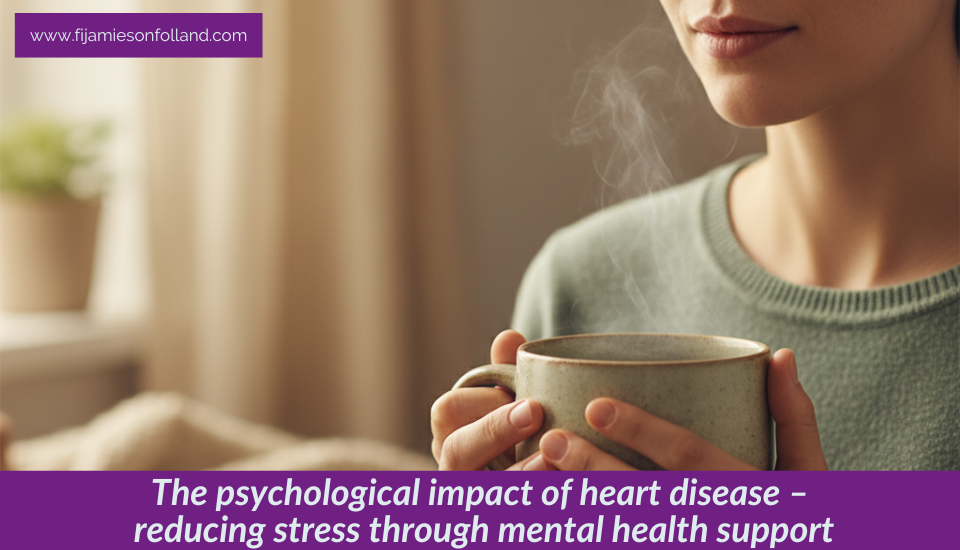
So in this conversation today—because I want it to feel like we’re sitting together with a cup of herbal tea, really talking this through—I want to open up the layers of what heart disease can do to our mental health, how stress can sneak into the cracks, and most importantly, how each of us can create a support system that doesn’t just treat the symptoms – it truly nurtures both our hearts and our spirits.
The reason the mind and heart are more connected than we think
It’s so easy to think of the heart as a pump and the brain as the control centre, two separate machines doing their jobs; however, the truth is they’re in constant conversation, whispering to each other through hormones, nerves, and signals that are far more potent than most people realise.
When you’re stressed, you most likely know that your body releases cortisol and adrenaline, which push your heart rate up and constrict your blood vessels. Now, if that happens occasionally—say you’re late for a meeting—it’s fine, your body resets. However, if it’s chronic and constant, if your baseline is always ‘on alert,’ then your heart and vessels stay under pressure, and that contributes to both the development and progression of heart disease.
However, here’s the twist – it doesn’t stop there.
The diagnosis itself creates a feedback loop. When someone hears, ‘You have heart disease,’ the shock alone can trigger depression, anxiety, even post-traumatic stress. And once those emotions set in, they change behaviours—less motivation to exercise, comfort eating, withdrawal from social life—which then worsen the physical condition. It becomes a negative loop, one feeding the other.
The silent weight of fear and uncertainty
I remember a client once telling me, ‘Every time my heart skips a beat, I get a twinge of fear.’ That kind of hyper-vigilance is common after a heart scare. People become acutely aware of every sensation, every flutter, every moment of breathlessness. Living in that constant state of alertness can be exhausting, even paralysing.
What’s fascinating is that the fear often spreads into unrelated areas – people hesitate to travel, to dance, to make love, even to laugh too hard, because in their minds, anything could ‘set the heart off.’ The result is a shrinking life, where joy is trimmed away by worry.
That’s why mental health support isn’t a luxury; it’s an essential part of recovery. Without addressing the emotional burden, the fear keeps the nervous system locked in fight-or-flight mode, and healing never fully takes root.
Stress is both a cause and a consequence
Stress plays a double role in heart disease—it’s both the spark that lights the fire and the fuel that keeps it burning. We know from countless studies that high stress levels contribute to hypertension, irregular heart rhythms, and increased inflammation in the body. However, once heart disease develops, the condition itself becomes a stressor. Suddenly, there are hospital visits, new medications, financial concerns, lifestyle adjustments, and maybe even restrictions on driving or working.
And if someone already had perfectionist tendencies or was the type to ‘power through,’ heart disease often cracks that identity wide open. They can’t push as hard as they once did, and that in itself becomes stressful because their sense of self-worth feels threatened.
The key is learning to see stress not as something we can magically erase – rather as a signal, a messenger asking us to pause, to reassess, to build new ways of living.
Different faces of mental health challenges after heart disease
One thing I’ve seen repeatedly is that not everyone responds the same way emotionally after a diagnosis. Some dive into action mode, researching, making changes, almost trying to outsmart the condition. Others collapse into despair, unable to imagine a future. And many fluctuate between the two.
Here are some of the most common psychological responses –
Depression – feelings of hopelessness, loss of interest in things once enjoyed, difficulty in maintaining routines.
Anxiety – constant worry about symptoms, catastrophising, panic attacks triggered by physical sensations.
Post-traumatic stress – prevalent after a heart attack or surgery, where flashbacks and nightmares occur.
Adjustment disorder – struggling to cope with the lifestyle changes demanded by the condition.
Social isolation – withdrawing because others don’t understand, or out of embarrassment about limitations.
Each of these needs a different approach, which is why cookie-cutter advice doesn’t work—we must personalise mental health support just as much as we personalize medication.
Why talking therapy matters more than we think
I’ll be honest – when I was first told I might die young, I wanted to hide – I didn’t want to talk to anyone about it. I thought, ‘What’s the point? Talking won’t change my diagnosis.’ However, what I didn’t realise is that talking changes our brains. Cognitive-behavioral therapy, for instance, helps break the cycle of catastrophic thoughts and teaches the mind to challenge them with evidence.
For example, instead of thinking, ‘this chest tightness means I’m having an attack,’ therapy helps reframe – ‘this could be anxiety, it could be indigestion—let’s monitor, breathe, and use the plan I’ve discussed with my primary healthcare practitioner.’ That small shift reduces panic, and reduced panic means less physiological strain on the heart.
Other forms of therapy—like mindfulness-based stress reduction, acceptance and commitment therapy, or group counselling—bring community and coping tools that go beyond what any medication can provide.
The underrated power of support groups
There’s something profoundly healing about being in a room—or even a virtual circle—with people who just get it. You don’t have to explain why you’re scared, or why you’re tired, or why you sometimes cry for no reason, because everyone there has walked a similar path.
Support groups counteract isolation, provide models of resilience, and often give practical tips that professionals might overlook—like which types of exercise classes feel welcoming, or how to navigate a family gathering when you’re avoiding alcohol.
And perhaps most importantly, they remind people that heart disease doesn’t erase identity. You can still be vibrant, funny, adventurous—you’re not reduced to ‘the patient.’
Practical strategies for reducing stress daily
Now, here’s where I want to shift gears a little, because advice can so easily sound repetitive – ‘Meditate, eat well, exercise.’
And yes, those are crucial; however, let’s sprinkle in some fresh ideas too.
Micro-moments of calm – instead of waiting for a 30-minute meditation slot, weave in 60-second pauses throughout your day.
A breath at the traffic light.
A stretch before opening an email.
… these micro-moments reset your nervous system more often.
Creative outlets – painting, gardening, playing an instrument—these activities quiet the analytical brain and activate flow states, which lower stress hormones.
Laughter therapy – I know it sounds whimsical, however, genuine laughter improves vascular function. Watch a comedy, join a laughter yoga session, or simply recall a hilarious memory until you chuckle.
Nature immersion – not just walking, however intentionally noticing – the colour of leaves, the sound of birds, the texture of bark. This sensory grounding anchors you in the present.
Compassion practice – directing kindness toward yourself rather than judgment. When we say, ‘I’m doing my best today,’ our cortisol drops.
Integrating mental health into cardiac care
One of my frustrations with the medical system (as at the time of writing) is that cardiology and psychology are still often separated, when in reality they’d be wise to regarded as linked. 1
A heart patient is ideally automatically screened for depression and anxiety, and a referral to counselling needs to be as routine as prescribing a statin would be for a medical doctor.
Hospitals that have integrated care models—where cardiologists, psychologists, dieticians, and coaches all collaborate—see better outcomes. Patients recover faster, adhere to medication better, and report higher quality of life.
It’s time for us to move from a model of ‘fixing the pump’ to ‘healing the whole person.’
Redefining resilience after diagnosis
Resilience doesn’t mean pretending nothing happened or forcing a cheerful face when you’re scared inside. True resilience is adapting—allowing yourself to feel grief, then choosing to build new strengths around it.
I see clients who become passionate mentors, helping newly diagnosed patients. Others rediscover old hobbies, or reconnect with family in deeper ways. Some find spirituality; others become positive activists. The point is – resilience is personal, and it blossoms when you give yourself permission to grow in unexpected directions.
The role of loved ones in mental health support
It’s not possible to talk about stress reduction without mentioning family and friends, because they can either be anchors or additional stressors. Sometimes partners hover with too much fear, making the patient feel smothered. Other times, families minimise the condition, leaving the person feeling unseen.
The healthiest dynamic is honest communication. Saying, ‘I need you to listen, not fix,’ or ‘I want encouragement to walk, however not pressure if I’m tired,’ helps loved ones support in ways that actually soothe rather than strain.
Caregiver support is also vital. Spouses and children often carry silent anxiety, and if they burn out, the whole household suffers. Encouraging them to join support networks or counselling ensures the well-being of everyone involved.
Hope as medicine
Perhaps the most overlooked factor in heart health is hope. When people believe in their ability to improve—even incrementally—they engage in healthier behaviours and experience less stress.
Hope doesn’t mean denial; it means seeing possibilities. Maybe it’s not wise to run marathons anymore, however you can hike. Maybe you can’t eat everything you used to, however you can discover new cuisines. Maybe you live with medication, however you also live with vitality.
That shift in perspective transforms stress into motivation, and it gives the heart what it craves most – a reason to keep beating strong.
Conclusion – the heart and mind as allies
So when we talk about the psychological impact of heart disease, let’s remember it isn’t an add-on topic—it’s central to healing. Stress, fear, depression, anxiety—they don’t just cloud your mood, they shape your biology.
However, with the right support—therapy, community, practical strategies, compassionate loved ones—you can break the vicious cycle and create a virtuous one, where peace of mind supports heart health, and a stronger heart gives your mind confidence in return.
I often think back to that young version of myself, twenty-one, terrified of the future. If I could sit with her now, I’d say, ‘Yes, this diagnosis feels huge; however, you are bigger than it. You do find joy again, laughter again, love again. And you discover that your heart is not just a pump, it’s a compass—it will guide you toward a life worth living.’
And I believe that for you, too.
See you on this week’s #AlivewithFi 🙂
Fi Jamieson-Folland D.O., I.N.H.C., is The LifeStyle Aligner. She’s an experienced practitioner since 1992 in Europe, Asia and New Zealand as a qualified Osteopath, Integrative Nutrition Health Coach, speaker, educator, writer, certified raw vegan gluten-free chef, and Health Brand Ambassador.

Facebook Instagram LinkedIn Pinterest YouTube
1 Research showing the effectiveness of relaxation techniques for stress management and quality of life improvement in cardiovascular disease and hypertensive patients –
https://www.tandfonline.com/doi/full/10.1080/13548506.2025.2458255#d1e2312