
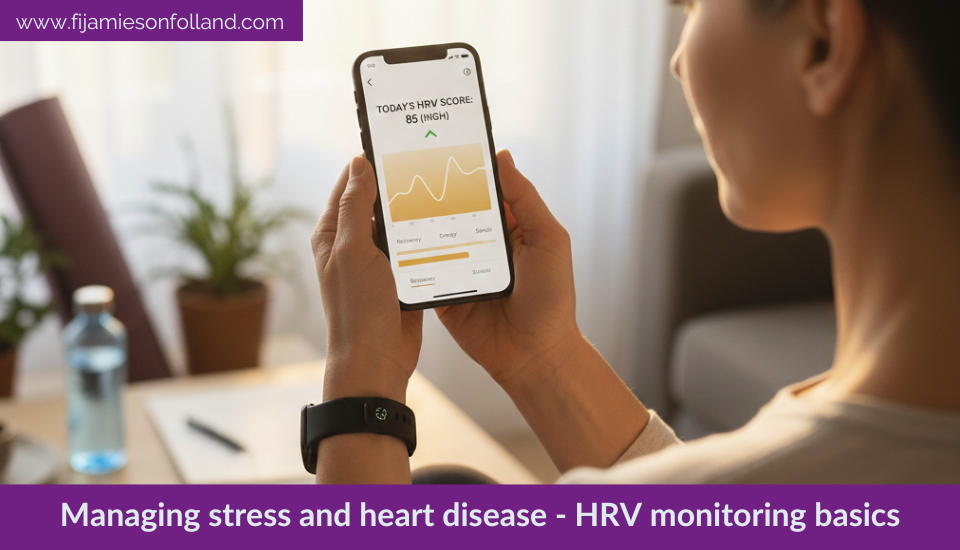
Stress and heart disease are often spoken about in the same breath, yet rarely do we slow the conversation down enough to understand how stress actually imprints itself onto the heart in measurable, reversible, and deeply personal ways, because stress is not just something you feel emotionally, it’s something your nervous system lives within, something your heart listens to moment by moment, and something your body adapts to whether you’re aware of it or not.
Stress isn’t a moral failing or a personality flaw – it’s a physiological state that can either support resilience or quietly erode cardiovascular health over time, depending on how often the body is allowed to return to balance.
This is where heart rate variability, or HRV 1, becomes one of the most valuable, compassionate, and empowering tools we have, because it doesn’t judge or shame, and it doesn’t demand perfection; it simply reflects how well your nervous system is balancing between effort and recovery.
To understand why HRV matters so deeply in our conversation about stress and heart disease, we first need to release the idea that a steady heart rhythm is the goal, because counterintuitive as it may sound, a healthy heart is not metronomic, it is flexible, responsive, and adaptive, constantly adjusting the space between beats based on what the body’s needs in that moment.
How is HRV useful?
HRV measures the variation in time between heartbeats, not the speed of the heart itself, and this variation is a direct window into the balance between the sympathetic nervous system, which mobilises energy and prepares us to act, and the parasympathetic nervous system, which restores, repairs, heals, and calms.
When stress is chronic, relentless, or unprocessed, the nervous system becomes biased toward vigilance, and HRV tends to decline, signalling that the heart is spending more time braced for action and less time in recovery.
This does not mean something is broken, it means the system has been doing its job too well for too long.
Is stress ‘bad’?
One of the most important shifts I help people make is moving away from seeing stress as something to eliminate and toward understanding stress capacity, because stress itself is not the enemy, the problem arises when there is insufficient recovery to balance it.
Your heart can handle challenge beautifully when it’s paired with rest, meaning, and safety.
HRV allows us to see this balance or imbalance in real time, offering insight into how lifestyle, emotions, sleep, movement, and even thoughts are shaping cardiovascular resilience.
For someone living with or at risk of heart disease, this insight can be transformative, because it replaces vague advice like ‘manage your stress’ with tangible feedback that shows what actually helps your body (specifically) recover.
Monitoring HRV does not require obsession or constant checking, and in fact over-monitoring can become its own form of stress, however when used gently and consistently, it becomes a conversation with your nervous system rather than a performance metric.
Think of HRV as a daily check-in that asks how supported does your body feel today.
Higher HRV generally reflects greater adaptability, meaning the heart and nervous system can respond to stress and return to baseline efficiently, while lower HRV suggests the system may be under strain, asking for rest, nourishment, or emotional processing.
Neither state is good or bad, they are simply information.
Adaptive
One of the most fascinating aspects of HRV is how quickly it can change, sometimes within days or even hours, which reminds us that stress physiology is not fixed, it is dynamic, and this is deeply hopeful for heart health.
A single night of restorative sleep, a meaningful conversation, a walk in nature, or a breathing practice can measurably improve HRV, not because these things are trendy, however because they signal safety to the nervous system.
When the nervous system perceives safety, the heart softens, variability increases, inflammation settles, and energy distribution becomes more efficient.
This is why stress management for heart disease is not about doing more, it is about creating conditions where the body feels safe enough to recover.
So how does stress actually contribute to heart disease at a physiological level?
Chronic stress increases sympathetic nervous system activity, elevates stress hormones, disrupts blood sugar regulation, increases inflammatory signalling, alters vascular tone, and affects heart rhythm patterns, all of which place additional workload on the cardiovascular system.
Over time, this constant activation can contribute to arterial stiffness, endothelial dysfunction, and reduced cardiac efficiency, not because the heart is failing – rather it’s responding to persistent demand.
HRV reflects this story beautifully, showing us when the body is stuck in activation and when it is able to downshift.
For many people, the most surprising discovery when they begin tracking HRV is that the things they assumed were relaxing are not always restorative to their nervous system.
Scrolling on a phone, watching intense shows late at night, or pushing through exhaustion with stimulants may feel soothing on the surface, although HRV often reveals that these habits keep the nervous system alert rather than relaxed.
On the other hand, practices that seem almost too simple, like slow breathing, gentle stretching, or quiet time without stimulation, often produce noticeable improvements in variability.
This is not about giving up modern life, it is about becoming fluent in your own physiology.
Emotional and physical
HRV monitoring also helps untangle the relationship between emotional stress and physical recovery, which is especially important for heart health.
Emotions are not abstract experiences floating above the body, they are biochemical and neurological events that influence heart rhythm patterns in real time.
Unprocessed grief, chronic worry, suppressed anger, or constant mental pressure all register in the nervous system, and HRV can reflect these states even when someone believes they are coping well.
This is not a failure of mindset, it is an invitation to acknowledge that emotional health and heart health are inseparable.
One of the most powerful uses of HRV is learning how your body responds to different types of stress, because not all stress is equal.
Physical exertion, cognitive workload, emotional strain, environmental noise, and social pressure all activate the nervous system differently, and HRV can help identify which stressors are most taxing for you personally.
For one person, intense workouts may dramatically lower HRV if recovery is insufficient, while for another, emotional conflict or poor sleep may be the dominant factor.
This individualised feedback allows heart health strategies to be tailored rather than generic.
Recovery becomes intentional rather than accidental.
Rest
Sleep deserves special attention here, because it is one of the strongest predictors of HRV trends over time.
Quality sleep supports parasympathetic dominance, hormonal recalibration, and tissue repair, all of which enhance variability.
Fragmented or insufficient sleep, even if someone spends enough hours in bed, often suppresses HRV, signalling that the nervous system did not fully downshift.
This is why managing stress for heart disease is inseparable from protecting sleep, not just duration – it’s about depth and consistency.
Evening routines, light exposure, emotional decompression, and a sense of closure to the day all influence how the nervous system behaves overnight.
Movement
Movement also interacts with HRV in nuanced ways that are especially relevant for people focused on heart health.
Gentle movement often increases variability by promoting circulation and nervous system balance, while excessive intensity without recovery can suppress it.
This does not mean intensity is harmful, it means timing and dosage matter.
HRV can guide these decisions by showing when the body is ready for challenge and when it would benefit more from restoration. This turns exercise into a conversation rather than a command.
Breathing
Breathing practices deserve their own moment, because they are one of the most direct ways to influence HRV in real time.
Slow, rhythmic breathing stimulates the vagus nerve, enhances parasympathetic activity, and increases variability, often within minutes.
This is not mystical, it is mechanical and neurological, and it gives people a sense of agency over their stress physiology.
In moments of acute stress, breathing can stabilise heart rhythm patterns quickly, and with regular practice, it can shift baseline HRV over time.
We are what we ate
Nutrition also plays a role in stress resilience and HRV – via stability rather than through restriction.
Erratic eating patterns, blood sugar swings, and inadequate nourishment can activate stress pathways, while consistent, balanced meals support nervous system calm.
HRV often improves when the body feels reliably fuelled, reminding us that stress management is not only emotional, it is metabolic.
‘Failure’ or learning?
One of the most healing aspects of working with HRV is how it reframes setbacks.
A low HRV day is not a failure, it is a signal.
It might be asking for rest, connection, gentleness, or simply awareness.
When people stop fighting these signals and start responding to them, the nervous system learns that it is being listened to, and variability often improves as a result.
This relational aspect of physiology is rarely discussed, yet it is central to sustainable heart health.
Over time, patterns emerge.
You begin to see how travel affects you, how certain social dynamics drain or nourish you, how seasons, workloads, and life transitions influence your stress capacity.
HRV becomes less about daily numbers and more about long-term trends, helping you make decisions that align with your health rather than constantly reacting to symptoms.
For those managing heart disease or aiming to prevent it, this awareness can be profoundly stabilising.
Instead of living in fear of stress, you learn how to ‘be’ with it.
Instead of pushing through exhaustion, you learn how to recover.
Instead of guessing what your heart needs, you begin to understand its language.
Managing stress and heart disease is not about creating a stress-free life, it’s about building a resilient nervous system that can move fluidly between effort and ease.
HRV monitoring offers a practical, compassionate bridge between awareness and action, allowing heart health to be guided by feedback rather than fear.
Your heart is not asking you to escape the world, it’s asking you to listen more closely, respond more kindly, and create enough space for recovery so that stress no longer becomes a chronic state.
When that balance is restored, the heart does what it has always done best, adapt, endure, and thrive.
See you on this week’s #AlivewithFi 🙂
Fi Jamieson-Folland D.O., I.N.H.C., is The LifeStyle Aligner. She’s an experienced practitioner since 1992 in Europe, Asia and New Zealand as a qualified Osteopath, Integrative Nutrition Health Coach, speaker, educator, writer, certified raw vegan gluten-free chef, and Health Brand Ambassador.

Facebook Instagram LinkedIn Pinterest YouTube
1 Heart Rate Variability- Standards of measurement, physiological interpretation, and clinical use –
https -//www.ahajournals.org/doi/10.1161/01.cir.93.5.1043