
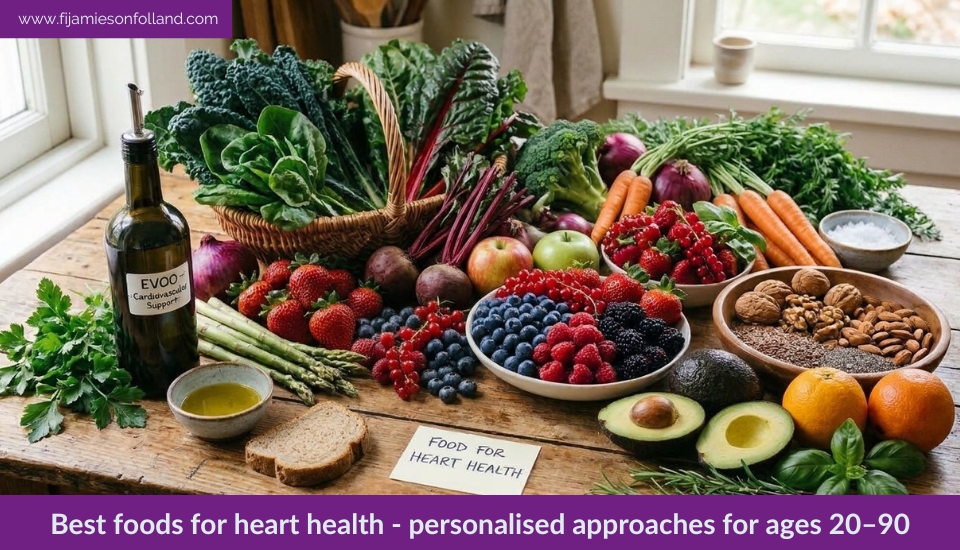
When we talk about eating for heart health, it can be tempting to look for a simple list of ‘good’ foods and ‘bad’ foods, however the truth is much more interesting than this list.
This is because your heart, metabolism, muscle mass, lifestyle and nutritional needs can look completely different at 20 than they do at 50, 70 or 90. The foods that support your heart throughout life are not necessarily about following a rigid diet; they’re about creating a pattern of eating that gives your body the raw materials it needs for healthy blood vessels, balanced energy, a resilient gut microbiome and good metabolic function, while also being enjoyable enough that you actually want to keep doing it.
Your 20s and 30s – build the foundations
Your younger years are a wonderful opportunity to build habits that can quietly influence your cardiovascular health for decades to come. Rather than waiting until an oxidised-cholesterol result, blood pressure reading or family history suddenly gets your attention (as it did for me), think of these years as your nutritional investment period.
This is the time to become generous with colourful vegetables, berries and other whole fruits, extra-virgin olive oil, avocado, nuts and seeds, legumes if they suit your digestion, and good-quality sources of protein such as fish, eggs and minimally processed plant protein products (if they suit your digestion). These foods provide fibre, minerals, antioxidants, healthy fats and protein without requiring you to become obsessed with counting every calorie.
One of my favourite principles for this age group is simply to make your plate more colourful. Different plant foods contain different polyphenols and phytonutrients, so instead of eating the same two vegetables every night, rotate your colours through the week. Think deeply coloured berries, leafy greens, tomatoes, beetroot, capsicum, broccoli, herbs, onions and brightly coloured vegetables.
And remember the importance of healthy fats.
Your heart does not need a fat-free diet! Extra-virgin olive oil, avocado, walnuts, almonds, nut butters, chia and flaxseed can become part of a heart-supportive eating pattern while also making meals much more satisfying.
Your 40s and 50s – think metabolic health
By your 40s and 50s, life can become extraordinarily busy, and this is often the stage when nutrition needs to become less about restriction and more about metabolic consistency.
This is where it’s wise to pay particular attention to the quality of our carbohydrates. You don’t necessarily need to eliminate carbohydrates, however there’s a world of difference between eating whole foods such as vegetables, berries, legumes or naturally occurring carbohydrate-rich foods and relying heavily on refined, highly processed options.
Protein also becomes increasingly important. Including a quality source of protein at each meal can support muscle maintenance and satiety, while combining it with vegetables, healthy fats and fibre creates a meal that is much more metabolically balanced than simply grabbing something sweet when energy crashes in the afternoon.
This is also an excellent decade to become intentional about
omega-3-rich foods. Pre-soaked and drained walnuts, chia and flax provide plant-based ALA, whilst oily fish such as sardines, salmon, trout and mackerel provide EPA and DHA.
Variety matters, so think about rotating your sources rather than relying on one food.
Your 60s and 70s – protect the heart and the muscle
As we move into our 60s and 70s, heart health and muscle health become increasingly intertwined. A beautifully healthy-looking salad is not necessarily a complete meal if it leaves you hungry and provides very little protein.
This is where it’s effective to build meals around three anchors – protein, plants and healthy fats.
A breakfast might be tofu with vegetables and avocado, lunch could be a large salad with plant-based sausages, olive oil and pre-soaked and drained seeds, while dinner might centre around fish or another quality protein alongside roasted vegetables and a drizzle of extra-virgin olive oil.
Nuts and seeds are particularly useful because they deliver healthy fats, minerals, fibre and energy in a very small package. A small handful of pre-soaked and drained walnuts or almonds can be an easy addition to breakfast or a snack, while pre-soaked and drained pumpkin and sesame seeds can add protein, texture and minerals to salads and vegetables.
And remember hydration!
Sometimes what looks like a lack of energy or appetite can be influenced by simply not drinking enough fluid throughout the day, particularly as thirst perception can change with age.
Interestingly, a 2024 systematic review and meta-analysis examining Mediterranean-diet adherence in older adults included 28 studies involving more than 679,000 participants and found that higher adherence was associated with lower risks of all-cause mortality and cardiovascular mortality. 1
Your 80s and 90s – nourishment becomes the priority
Once we reach our 80s and 90s, the conversation changes again. This is not the time to become frightened of food or unnecessarily restrictive.
Maintaining adequate nourishment, strength, hydration and enjoyment becomes incredibly important. If appetite is smaller, nutrient density matters even more. Instead of focusing on enormous meals, think about smaller meals containing concentrated nutrition – avocado, nut and seed butters, full-fat plant foods that suit the individual, oily fish, vegetables cooked until tender, berries and other fruits, and easy-to-eat sources of protein.
Texture can matter too. A person who struggles to chew raw vegetables may happily eat a nourishing vegetable soup, protein-green smoothie, stew or slow-cooked meal. The ‘perfect’ food is not particularly useful if someone cannot comfortably eat it.
And this is where personalisation becomes essential. Someone who is highly active at 25 may need a very different balance of food from someone who is 85 and has a smaller appetite. Someone with a strong family history of cardiovascular disease may need to pay closer attention to their overall dietary pattern much earlier in life, while someone with digestive sensitivities may need to modify otherwise healthy foods according to their individual tolerance.
The heart-health plate that works across generations
If you want one simple framework that can travel with you from your 20s into your 90s, think about building most meals around whole, minimally processed foods and ask yourself four questions –
1. Where is my protein?
2. Where are my colourful plants?
3. Where is my healthy fat?
4. What will nourish my body rather than simply fill my stomach?
That might mean marinated tofu with roasted vegetables and olive oil, plant-based sausages with spinach and avocado, a colourful salad topped with pre-soaked and drained nuts and seeds, berries with pre-soaked chia seeds, or a vegetable-rich soup with a quality protein source.
There is no single magical heart-health food, and there certainly isn’t one perfect diet for every person or every decade. Your nutritional needs evolve as you age, your lifestyle changes, your activity level changes and your body changes.
The real goal is much simpler and much more powerful – build a way of eating that is rich in whole foods, diverse in plants, generous in nutrients, enjoyable enough to sustain and flexible enough to evolve with you.
Because heart health isn’t something you suddenly start thinking about at 60.
It is something you nourish, meal by meal, decade by decade.
See you on this week’s #AlivewithFi ☺
Fi Jamieson-Folland D.O., I.N.H.C., is The LifeStyle Aligner. She’s an experienced practitioner since 1992 in Europe, Asia and New Zealand as a qualified Osteopath, Integrative Nutrition Health Coach, speaker, educator, writer, certified raw vegan gluten-free chef, and Health Brand Ambassador.

Facebook Instagram LinkedIn Pinterest YouTube
1 Research reference – ‘Mediterranean Diet in Older Adults – Cardiovascular Outcomes and Mortality from Observational and Interventional Studies—A Systematic Review and Meta-Analysis’ — Nutrients, 2024
https -//pubmed.ncbi.nlm.nih.gov/39599734/