
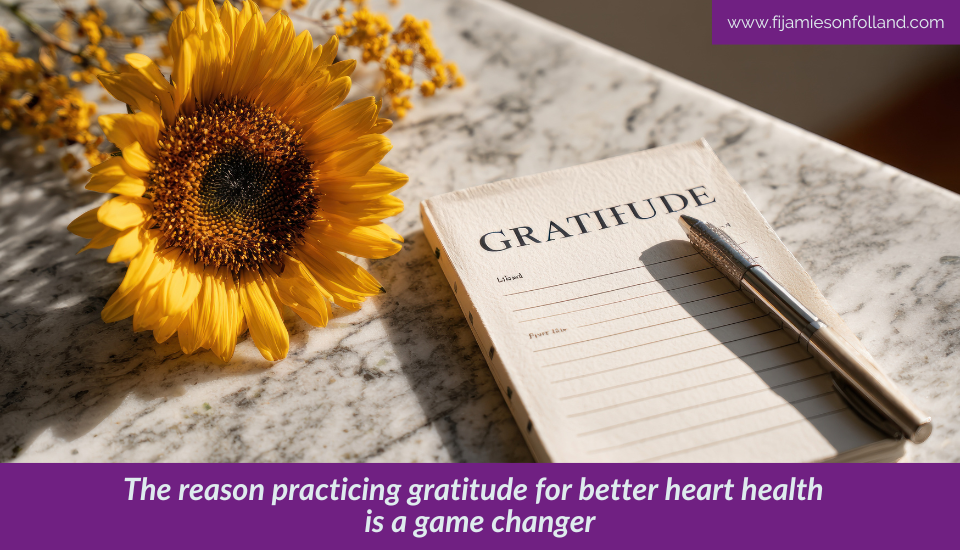
When we talk about heart health, most people immediately think about cholesterol levels, blood pressure numbers, or whether they’re hitting their 10,000 steps a day, and of course whilst all of those things matter enormously, what I’ve found in both my personal journey and decades of coaching others is that there’s another layer to the heart story, a quieter one.
This one is often overlooked and yet is deeply powerful.
It’s the practice of gratitude. It’s not just about saying thank you when someone holds the door or sends you flowers, it’s a rewiring of your inner landscape, a way of shifting the nervous system from the storm of stress into the sanctuary of calm, and believe me, this shift can be a total game changer for your heart.
Why gratitude touches the heart in more ways than one
Let’s start with the science, because while gratitude sounds like something soft and fluffy, it’s actually backed by some surprisingly strong data 1 and the research shows that when you practice gratitude regularly, your body responds in measurable, physical ways, your cortisol (one of the stress hormones) lowers, your heart rate variability improves (which is a marker of resilience in your nervous system), and your blood pressure tends to normalise…so what does that mean in real life terms?
It means your heart gets a break, your cardiovascular system stops feeling like it’s always under siege, and your emotional state shifts toward greater positivity, which reduces the triggers for stress-eating, late-night worry sessions, and skipped workouts, all of which are stealth saboteurs of heart health.
And here’s the beautiful part – gratitude doesn’t have to come in huge dramatic doses, you don’t need to be thankful for a lottery win or a life-changing miracle (though if that happens, soak it in J), you can be grateful for the sunlight coming through your kitchen window, for the friend who texted you just to say hi, or for the way your lungs fill with fresh air during a morning walk, because each of these small acknowledgments signals to your brain and body that life, even with its challenges, has moments worth cherishing, and that mindset alone can lighten the load your heart carries.
Stress and the silent burden on your heart
Here’s something I want you to take in deeply – chronic stress is one of the most underestimated risk factors for heart disease, and I’m not just talking about having a tough day here or there, I mean the relentless, grinding, low-level stress that hums in the background when you’re juggling work deadlines, caring for family, paying bills, worrying about the future, and rarely giving yourself permission to pause.
That kind of stress floods your system with cortisol and adrenaline, keeping your heart in a constant state of ‘go, go, go,’ and over time, that accelerates arterial damage, raises your risk of arrhythmias, and keeps your blood pressure stubbornly high.
Now, gratitude steps in here like a counterbalance, because the very act of pausing to notice what’s good, what’s working, what’s precious, interrupts the stress spiral. Gratitude doesn’t erase your to-do list or your challenges, however it softens the physiological blow by activating the parasympathetic nervous system, often called the ‘rest and digest’ mode (I call it rest, digest and heal mode), the place where your heart gets to beat calmly, steadily, and efficiently instead of hammering away like a drum in a rock band.
The neurochemistry of thankfulness
If you’ve ever wondered whether gratitude is ‘just in your head,’ let me reassure you – it’s very much in your brain chemistry, and therefore your body. When you express gratitude, your brain releases dopamine and serotonin, those feel-good neurotransmitters that act like natural antidepressants, and they don’t just lift your mood for a moment, they create a feedback loop where your brain starts scanning for more positive things to notice, which builds resilience over time.
And here’s the kicker – these neurochemicals also influence your cardiovascular system, because when you feel calmer and more uplifted, your blood vessels dilate more easily, your blood pressure eases down, and your heart rate finds its rhythm again, so gratitude is not just a ‘nice thought,’ it’s biochemistry at work for your heart’s benefit.
Building a gratitude practice that sticks
Now, let’s talk practical, because I don’t want this to sound like another wellness cliché you try for a week and then abandon. Gratitude practices need to feel natural, doable, and genuine, otherwise they become another chore on your already packed list.
One of my favourite ways is to literally jot down 5 things I’m grateful for each day (I post mine in a SM group I’m a part of – and have been doing this each day for over 7 years at the time of writing this)
Another is gratitude moments, where you pause before a meal, before bed, or even in the middle of a stressful meeting, and silently note something you’re thankful for. For those who are more auditory than written, there’s the gratitude voice note tip, where you record a 30-second thank-you to yourself, the universe, God or someone in your life, and play it back later when stress hits hard.
The key is consistency —sometimes it might be journaling, sometimes it’s a text of appreciation, sometimes it’s a mindful pause while sipping tea or pausing to breathe deeply. Your heart doesn’t care about the format – it cares about the consistent signal that safety, calm, and appreciation exist in your world.
Gratitude and relationships – the heart’s social shield
There’s another dimension we often overlook, and that’s how gratitude strengthens relationships, because when you express appreciation to your partner, your kids, your colleagues, even the barista who remembers your order, you create tiny moments of connection, and these moments act as protective buffers against loneliness and isolation, which are massive risk factors for heart disease.
Studies have shown that people who feel supported, loved, and connected recover faster from cardiac events, they stick more closely to their treatment plans, and they’re more likely to adopt heart-healthy behaviours, and gratitude is one of the simplest, most cost-effective ways to build and maintain those supportive bonds.
Gratitude as a morning reset
One of the most powerful ways to integrate gratitude into your life is in the morning, because how you start your day sets the tone for how your body, especially your heart, responds to the world. Instead of reaching for your phone and scrolling through stressful news or emails, trial placing a sticky note by your bed that says, ‘what am I grateful for today?’ and allow yourself 60 seconds to answer. It might feel awkward at first, however over time, this practice rewires your default mode from stress to appreciation, which can ripple through your entire day, lowering stress responses and making your heart’s workload a little lighter.
When gratitude feels hard
Now, let’s be honest – there will be days when gratitude feels forced, maybe you’re grieving, maybe you’re exhausted, maybe life just feels unfair, and the idea of writing ‘I’m grateful for my cozy blanket’ feels hollow.
On those days, don’t push it, instead, practice what I call ‘gentle gratitude,’ which means acknowledging something neutral or basic, like ‘I’m grateful that I can breathe,’ or ‘I’m grateful that this moment will pass.’ Even the smallest, simplest acknowledgments still give your nervous system a foothold back toward balance, and with time, deeper gratitude will return naturally.
How gratitude supports long-term heart resilience
Think of your heart like a marathon runner—it’s not just about how it handles today’s sprint of stress, however how it holds up decade after decade. Gratitude is like building endurance training into your emotional fitness, because by practicing it consistently, you’re lowering the baseline level of stress hormones in your body, protecting your arteries from inflammation, and keeping your autonomic nervous system balanced.
And here’s something fascinating – gratitude has been linked to better adherence to lifestyle changes in cardiac patients, meaning people who feel grateful are more likely to stick with exercise programs and health-focused appointments, which directly improve outcomes. Gratitude, in other words, isn’t just a mood shifter—it’s a behaviour shaper, and these are what make or break long-term heart health.
Beyond personal practice – spreading the ripple effect
One of my favourite things about gratitude is how contagious it is. When you show appreciation, it often sparks others to do the same, creating an upward spiral of positivity in families, workplaces, and communities. And the collective effect is enormous—less tension, more cooperation, and yes, lower stress levels all around, which means healthier hearts for everyone involved.
Imagine if your workplace had a culture where gratitude was expressed openly, where colleagues acknowledged each other’s efforts regularly, where stress was balanced by genuine appreciation—do you think absenteeism would drop?
Burnout would lessen?
Absolutely, and every single one of those improvements translates to healthier cardiovascular systems across the board.
Putting it all together – gratitude as a lifestyle
At this point you might be thinking, ‘ok, I get it, gratitude is powerful, however how do I actually make it part of my lifestyle?’
Here’s my answer – start small, start specific, and start today.
Don’t wait for the perfect journal or the perfect meditation app; begin with what’s in front of you.
Maybe it’s sending a quick thank-you text to someone who made you smile last week, maybe it’s taking five slow breaths and appreciating the strength of your own heartbeat, maybe it’s writing down one thing before bed that made the day worthwhile.
Over time, these tiny practices weave together into a fabric of resilience that not only reduces stress in the moment, it also fortifies your heart against the pressures of life, and that’s the reason that I say with complete conviction – practicing gratitude for better heart health is an absolute game changer.
See you on this week’s #AlivewithFi 🙂
Fi Jamieson-Folland D.O., I.N.H.C., is The LifeStyle Aligner. She’s an experienced practitioner since 1992 in Europe, Asia and New Zealand as a qualified Osteopath, Integrative Nutrition Health Coach, speaker, educator, writer, certified raw vegan gluten-free chef, and Health Brand Ambassador.

Facebook Instagram LinkedIn Pinterest YouTube
1 Research showing the positive impact of gratitude interventions on patients with cardiovascular disease