
There can be a time for many of us when we recognise – long before it’s ever described in medical or clinical terms – a moment where movement begins to feel different than it used to.
This might be when we notice that our bodies no longer respond with the same ease, where anxiety seems to sit a little closer to the surface during rest or activity, and where strength feels like something that is slowly slipping into the background of daily life rather than being actively present in it.
What makes exercise so profoundly connected to both heart health and anxiety regulation is that it sits at the intersection of physiology, emotion, nervous system balance, and metabolic function, meaning that every time the body moves in a rhythmic and intentional way, it is also reshaping internal chemistry, emotional processing capacity, stress resilience, and cardiovascular efficiency all at once.
And yet, one of the most common misunderstandings about exercise is that it needs to be extreme, punishing, highly structured, or exhausting in order to be effective, when in reality the nervous system and cardiovascular system often respond far more positively to consistency, rhythm, and emotional safety within movement than to intensity alone.
When exercise is approached in a way that supports rather than overwhelms our bodies, it becomes not just a tool for physical strength – it becomes a stabilising force for emotional regulation and heart resilience over time.
How movement reshapes the stress response system
To understand why exercise is so effective for heart health and anxiety reduction, it helps to understand that the body does not separate emotional stress from physical stress, because both are processed through the same physiological pathways that regulate heart rate, breathing, muscle tension, hormone release, and nervous system activation.
When the body is inactive for long periods, stress can accumulate internally without an outlet, which often leads to a build-up of physiological tension that is not fully discharged through thinking or resting alone.
Movement provides that outlet.
When muscles contract rhythmically, when breathing becomes slightly deeper, when circulation increases, and when the body is placed in a state of gentle physical demand, the nervous system receives signals that help regulate excess activation, allowing stress chemistry to be metabolised and released rather than stored.
This is one of the reasons that many of us often feel mentally clearer after even a short walk, not because the problem has changed – it’s due to the internal physiological state shifting enough to allow a different perspective to emerge.
Exercise, in this sense, is not just physical training, it is nervous system communication.
The reason that the heart thrives on rhythm, not punishment
The heart is fundamentally a rhythm-based organ, constantly adjusting to internal and external cues, responding to breath, emotion, movement, sleep, and stress in real time, which means that the type of exercise most supportive of heart health is often the kind that enhances rhythm rather than disrupts it.
Highly erratic, overly intense, or emotionally stressful forms of exercise can sometimes add additional load to an already activated nervous system, particularly in individuals who are already experiencing anxiety, fatigue, or chronic stress.
In contrast, rhythmic movement patterns such as walking, swimming, cycling at a comfortable pace, yoga, or low to moderate strength training can help stabilise heart rate variability, improve circulation efficiency, and create a sense of internal coherence between breath, movement, and emotional state.
What is often overlooked is that the nervous system learns through repetition, so when movement is consistent, predictable, and non-threatening, the body begins to associate physical activity with safety rather than stress, which has long-term implications for both cardiovascular health and anxiety regulation.
Anxiety reduction through physical discharge of tension
Anxiety is not just a mental experience, it is a full-body state of activation that involves muscular tension, altered breathing patterns, increased heart rate, heightened alertness, and a sense of internal urgency that can persist even when external conditions are calm.
When this state becomes chronic, the body can feel as though it is constantly ‘on,’ even in moments of rest, because the physiological systems responsible for down-regulation are not being activated often enough to restore balance.
Movement helps complete stress cycles that would otherwise remain unfinished.
For example, a stressful thought may trigger a physiological response, and if left without movement, that energy remains partially stored in the body, whereas physical activity helps complete the cycle by allowing the nervous system to discharge excess activation through muscle engagement, breath rhythm changes, and cardiovascular adjustment.
This is the reason that even gentle movement can reduce anxiety symptoms, because it gives the body permission to move out of freeze or hyper vigilance states and return toward a more regulated baseline.
Over time, this creates a cumulative effect where the nervous system becomes more flexible and less reactive to stress triggers.
Building cardiovascular strength without overwhelming the system
One of the most important distinctions in exercise for heart health is the difference between building strength and pushing the body into exhaustion, because true cardiovascular strength is not measured by how depleted a person feels after a workout – it’s measured by how efficiently the heart and circulatory system adapt to varying levels of demand.
Strength in this context is about resilience, not strain.
The cardiovascular system becomes stronger when it is challenged within a manageable range and then allowed to recover fully, creating a cycle of stress and restoration that gradually improves efficiency, endurance, and adaptability.
However, when exercise consistently exceeds the body’s recovery capacity, especially in individuals with high stress loads or poor sleep, the nervous system can remain in a heightened state, which may counteract the intended benefits.
This is the reason that balance matters so deeply, because the goal is not to overwhelm the system into adaptation – instead it’s to guide it gently into greater resilience over time.
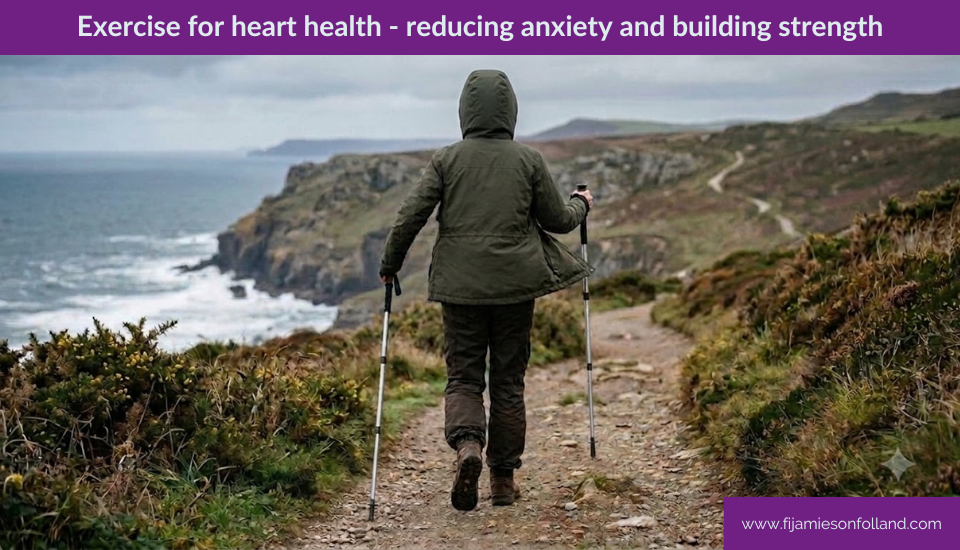
Walking as one of the most powerful heart–mind interventions
Walking is often underestimated because it appears too simple, too ordinary, or too gentle to create meaningful change, yet it is one of the most effective forms of exercise for both heart health 1 and anxiety reduction because it combines rhythm, breath, gentle cardiovascular stimulation, and nervous system regulation in a way that is highly sustainable.
When walking becomes a regular part of life, especially outdoors in natural environments, it supports circulation, improves metabolic efficiency, reduces stress hormone load, and creates space for mental processing without forced effort or intensity.
What makes walking particularly powerful is its accessibility, because it does not require motivation spikes, special equipment, or emotional pressure to begin, which means it can be used consistently even during periods of fatigue or emotional overwhelm.
Over time, walking becomes less about exercise and more about regulation – a daily reset for both mind and heart.
Strength training and emotional stability
While gentle movement supports regulation, strength training adds another layer of cardiovascular and emotional benefit when approached in a balanced way, because it supports muscle integrity, metabolic health, and long-term physical resilience.
Muscle tissue plays an important role in overall metabolic stability, and maintaining strength as the body ages contributes both to physical function and also to confidence, emotional steadiness, and perceived capacity to handle daily life demands.
Note however that the emotional tone of strength training matters just as much as the physical execution.
When strength training is approached with pressure, comparison, or urgency, it can activate stress pathways rather than regulate them, whereas when it is approached with intention, control, and awareness, it can become deeply grounding.
The key is not intensity alone – instead it’s mindful engagement with the body during movement, where breath, posture, and awareness remain integrated throughout the experience.
Breath and movement as a single system
One of the most powerful however often overlooked aspects of exercise for heart health is the relationship between breath and movement, because breathing patterns directly influence heart rhythm, oxygen delivery, nervous system state, and perceived exertion during physical activity.
When breath is shallow or held during exertion, the nervous system may interpret movement as stress, whereas when breathing remains steady and coordinated with movement, the body is more likely to interpret exercise as safe and sustainable.
This is particularly important for individuals experiencing anxiety, because breath awareness during movement can transform exercise from a stressor into a regulating experience.
Even simple awareness of exhalation during effort can significantly shift how the body responds to physical activity over time.
Overtraining, under recovery, and nervous system strain
One of the most common mistakes in modern exercise culture is the belief that more is always better, when in reality the cardiovascular and nervous systems require recovery just as much as they require stimulation.
When exercise is layered on top of chronic stress, poor sleep, emotional overload, or nutritional depletion, the body may struggle to fully recover between sessions, which can contribute to persistent fatigue, irritability, reduced motivation, and increased anxiety sensitivity.
This is not a sign of weakness – it’s a sign that the system is operating under cumulative load.
Rest is not separate from fitness, it is part of it.
The body becomes stronger during recovery, not during exertion itself, which is why sustainable exercise patterns always include periods of lower intensity, rest days, or restorative movement that allows the nervous system to reset.
Emotional tone during exercise matters more than people realise
Two people can perform the same physical activity and experience completely different physiological outcomes depending on emotional state, internal dialogue, and perceived pressure during movement.
If exercise is associated with guilt, punishment, or obligation, the nervous system may remain activated even during physical activity, whereas when movement is associated with care, self-support, and presence, the body is more likely to shift into a regulated state.
This is why mindset is not separate from physiology, it is part of it.
Learning to bring gentleness into movement can transform exercise from something that drains energy into something that restores it.
Creating a sustainable rhythm of movement for life
Long-term heart health is not built through occasional intense effort – it’s built through consistent patterns that the body can maintain across different seasons of life, emotional states, and energy levels.
This means that the best exercise plan is not the most complex or the most intense – instead it’s one that feels realistic, supportive, and adaptable.
Some days this may look like walking.
Some days it may include strength training.
Some days it may simply involve gentle stretching or restorative movement.
And some days it may simply involve rest.
What matters most is continuity over perfection, because the cardiovascular system responds most positively to predictable rhythm rather than unpredictable extremes.
Building a heart that feels safe to live inside
At its core, exercise for heart health and anxiety reduction is not just about fitness, it is about creating a relationship with the body where movement feels safe, supportive, and regulating rather than stressful or demanding.
When the body begins to trust movement again, when breathing becomes more natural, when strength feels accessible rather than pressured, and when exercise becomes a form of emotional release rather than emotional burden, the nervous system gradually shifts toward greater stability.
And from that place, the heart does not just become stronger, it becomes steadier, calmer, and more resilient in the face of everyday life.
See you on this week’s #AlivewithFi 🙂
Fi Jamieson-Folland D.O., I.N.H.C., is The LifeStyle Aligner. She’s an experienced practitioner since 1992 in Europe, Asia and New Zealand as a qualified Osteopath, Integrative Nutrition Health Coach, speaker, educator, writer, certified raw vegan gluten-free chef, and Health Brand Ambassador.

Facebook Instagram LinkedIn Pinterest YouTube
1 Research from the American Heart Association shows walking lowers chances of heart disease –https -//www.heart.org/en/healthy-living/exercise-and-physical-activity/walking/why-is-walking-the-most-popular-form-of-exercise?utm_source=chatgpt.com