
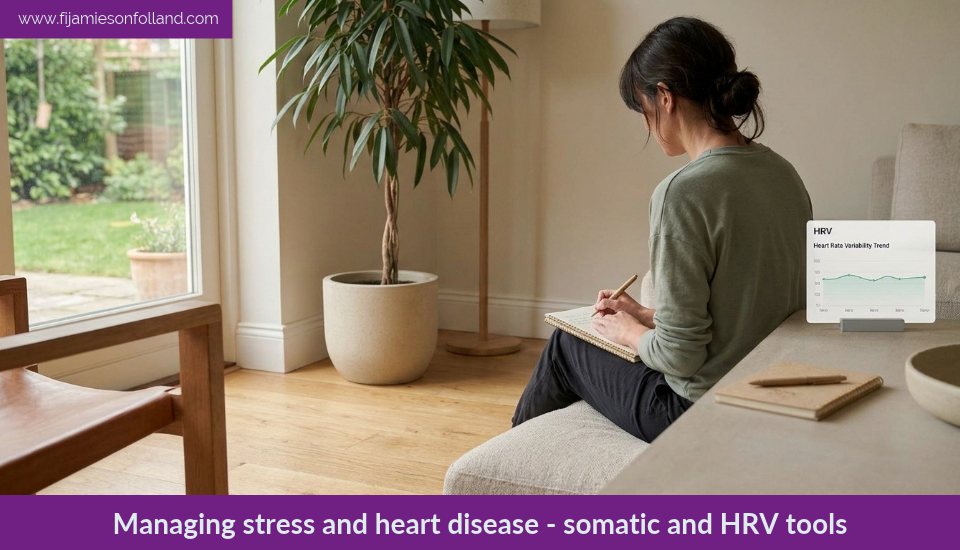
Stress is one of those words we hear so often that it can almost lose its meaning, however when we look at heart health through the lens of the nervous system – it’s a very different perspective.
This is because your body doesn’t simply experience stress as a thought in your head; it experiences it through your breathing, heart rate, muscle tension, digestion, sleep and the constant conversation between your brain and your autonomic nervous system.
And this is where somatic practices and heart rate variability, or HRV, can become such valuable tools. Instead of attempting to think your way out of stress, they give you practical ways to communicate with your body.
Understand what your body is telling you
Your autonomic nervous system is constantly adjusting between activation and recovery. When you’re rushing, worrying, exercising, working under pressure or responding to something that feels threatening, your sympathetic nervous system helps mobilise you. When the demand settles, your parasympathetic nervous system helps your body move back towards restoration.
The goal isn’t to eliminate stress because that simply isn’t realistic, and nor would we want to. The goal is to become better at moving between activation and recovery.
This is what we might think of as nervous-system flexibility. A resilient body isn’t one that never becomes activated; it’s one that can activate when necessary and then find its way back towards calm.
Start with the body rather than the mind
One of the simplest somatic tools is to notice what is happening physically before attempting to change it.
Pause for a moment and feel your feet against the floor. Notice whether your jaw is clenched, whether your shoulders are lifted, whether your stomach feels tight and whether your breathing is high in your chest or moving more comfortably through your ribcage.
You don’t have to fix anything immediately.
Simply noticing can create a tiny space between the stress response and your reaction to it.
Another helpful practice is orienting. Slowly look around the room and allow your eyes to settle on a few things that feel neutral or pleasant. Notice the light through the window, the colours around you, the sensation of the chair underneath you or the sounds outside.
You’re giving your nervous system information about the environment you’re actually in, rather than allowing it to remain completely absorbed in whatever problem is occupying your mind.
Let your breath become your anchor
Your breathing is one of the most accessible ways to influence the relationship between your mind, heart and nervous system because it is both automatic and consciously controllable.
Trial this – attempt making your breathing slightly slower and gentler rather than forcing enormous breaths into your lungs. Allow the inhale to arrive naturally and then make the exhale a little longer and softer.
You might experiment with inhaling for around four seconds and exhaling for around six, provided this feels comfortable for you. There is no prize for holding your breath or forcing a particular rhythm.
The intention isn’t to ‘breathe away’ heart disease. It’s to create regular opportunities for your nervous system to experience a slower, more regulated state.
A systematic review and meta-analysis involving 223 studies found that voluntary slow breathing increased vagally-mediated HRV during breathing, immediately afterwards and following multi-session interventions, supporting the potential role of slow breathing in autonomic regulation. 1
Use HRV as information, not a report card
HRV can be fascinating, particularly when you’re wearing a smart watch or another wearable that provides regular readings, however one of the biggest mistakes is becoming emotionally attached to the number.
A lower HRV reading doesn’t automatically mean something is wrong with your heart, just as a higher reading doesn’t guarantee perfect cardiovascular health. HRV can be influenced by sleep, exercise, emotional stress, recovery, illness, alcohol, breathing, time of day and many other factors.
Instead of asking ‘why is my HRV so low today?’ you might ask ‘what might my body be telling me?’
Look for patterns over time.
Perhaps your HRV tends to fall after several nights of poor sleep.
Maybe it changes during periods of emotional pressure.
Or it improves when you have quieter evenings, spend more time outdoors or reduce the intensity of your training.
That turns HRV from a number you might fear into a conversation with your body.
Create tiny recovery moments
You don’t need an hour-long meditation retreat to give your nervous system a chance to recover.
Attempt creating 3-minute transitions throughout your day..
Before opening your laptop, take 3 slower breaths.
Before getting into the car, relax your shoulders.
After a difficult conversation, walk outside for 5 minutes without your phone. Before dinner, consciously release your jaw and allow your breathing to soften.
These tiny moments can be surprisingly powerful because stress is often cumulative. It isn’t always one enormous crisis that leaves us feeling depleted; sometimes it’s the hundreds of small moments when we never quite come back down.
Give your heart somewhere peaceful to land
Perhaps the most important shift is to stop thinking about stress management as another task you have to perform perfectly.
Your heart doesn’t need you to become permanently calm.
It needs regular opportunities for recovery.
So notice your body.
Slow your breathing.
Move in a way that feels good.
Get outside.
Laugh with someone you love.
Spend time in nature.
Put your phone away for a while.
Listen to music that changes how you feel.
Let your shoulders drop.
Heart health isn’t only about what happens during exercise or what appears on a health report.
It’s also about the thousands of quiet conversations happening between your brain, your breathing, your heart and your nervous system every single day.
Learning to listen to those conversations may be one of the most valuable heart-health skills you ever develop.
See you on this week’s #AlivewithFi 🙂
Fi Jamieson-Folland D.O., I.N.H.C., is The LifeStyle Aligner. She’s an experienced practitioner since 1992 in Europe, Asia and New Zealand as a qualified Osteopath, Integrative Nutrition Health Coach, speaker, educator, writer, certified raw vegan gluten-free chef, and Health Brand Ambassador.

Facebook Instagram LinkedIn Pinterest YouTube
1 Research reference – ‘Effects of voluntary slow breathing on heart rate and heart rate variability – A systematic review and a meta-analysis’ — Neuroscience & Biobehavioral Reviews, 2022
https -//pubmed.ncbi.nlm.nih.gov/35623448/